
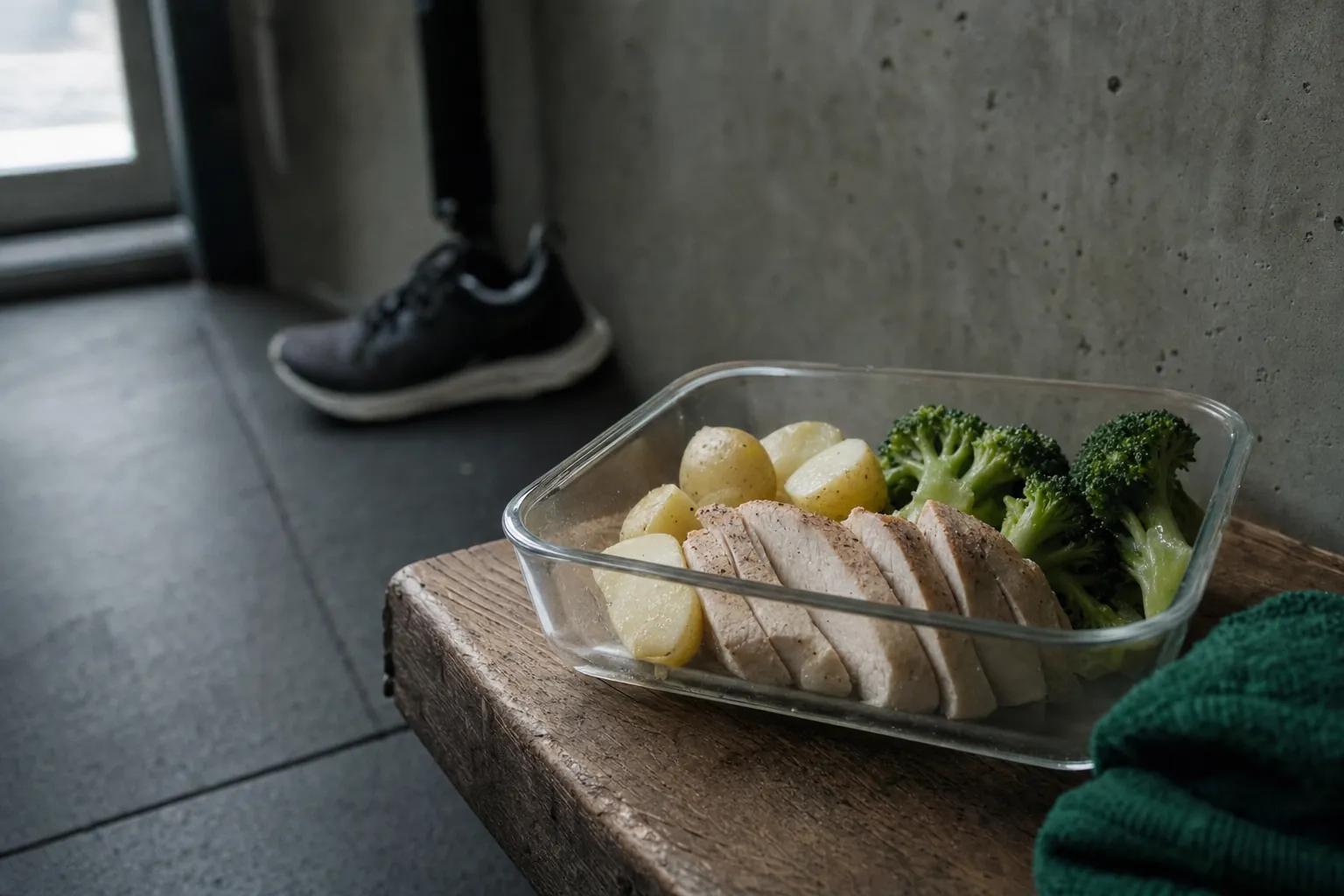
Short answer: a calorie deficit makes you lose weight, and strength training decides what that weight is. Eat less than you burn and the scale goes down. Lift 2-4 times a week and eat 1.6-2.2 g of protein per kg of body weight at the same time, and the weight you lose is mostly fat rather than muscle. A sensible pace is about 0.5-1% of body weight per week, which is 0.4-0.8 kg (about 0.9-1.8 lb) for someone weighing 80 kg, and a daily deficit of around 500 kcal is a good starting point for most people. According to the research, losing faster takes more muscle with it.
A familiar January pattern: the gym membership and the diet both start on the same Monday. In week one the scale shows two kilos less, by week three it has not moved at all, and meanwhile your bench press feels heavier than it did in the autumn. Neither means anything has gone wrong. This guide explains why, and how to set up weight loss with strength training so the fat goes and the muscle stays: the deficit, protein, lifting, steps, an example day of ordinary food and what to do when the scale stalls.
Calorie deficit: how big and how to work it out
Losing weight requires a calorie deficit: you eat less energy than you burn. No diet, supplement or training style gets around this, they can only make the deficit easier or harder to stick to. Your expenditure is made up of resting metabolism, everyday movement, training and digestion, and you can estimate it from your height, weight, age and activity level.
Start by estimating your expenditure with the TDEE calculator and subtract the deficit from it. The calorie deficit calculator does both at once and shows how long it takes to reach your goal weight with a 300, 500 or 750 kcal deficit. If you first want to know your maintenance level, the number of calories that keeps your weight stable, use the calorie calculator.
Calorie deficit and estimated weight loss for someone weighing 80 kg (7,700 kcal per kg)
| Daily deficit | Estimate per week | Of body weight |
|---|---|---|
| 300 kcal | 0.27 kg | 0.3% |
| 500 kcal | 0.45 kg | 0.6% |
| 750 kcal | 0.68 kg | 0.9% |
| 1,000 kcal | 0.91 kg | 1.1% |
The table is based on the rule of thumb that a kilo of body fat equals roughly 7,700 kcal. It is an estimate, not a law. At the start weight drops faster because of water, and later more slowly because a lighter body burns less. So the calculator result is a starting point that you correct after 2-4 weeks based on your actual weight trend.
A deficit that is too large shows up quickly: constant hunger, fatigue, poor sleep, feeling cold and training performance collapsing. If your gym weights drop week after week, the deficit is probably too big. The Finnish Current Care guideline for obesity does not recommend diets under 1,200 kcal a day unless it is a separately arranged very low energy diet, and SisuLift's calorie deficit calculator warns you if intake would drop below 1,200 kcal for women or 1,500 kcal for men.
How much weight can you lose per week?
For someone who lifts, a good target is 0.5-1% of body weight per week. The recommendation comes from a review by Helms, Aragon and Fitschen (2014, Journal of the International Society of Sports Nutrition), where the pace was set specifically to preserve muscle mass. The Finnish Current Care guideline recommends 0.5-1 kg per week in the treatment of obesity and notes that a moderate pace helps prevent muscle loss. In practice they land in the same place: 0.3-0.6 kg per week at 60 kg, 0.4-0.8 kg at 80 kg and 0.55-1.1 kg at 110 kg.
Why not faster? In a study by Garthe and colleagues (2011), elite athletes lost either 0.7% or 1.4% of their body weight per week. At the slower pace their lean mass increased by 2.1%, at the faster pace it did not change. The researchers concluded that athletes who want to lose weight while gaining muscle and strength should aim for about 0.7% per week. A slower pace does not mean a worse result, it means better body composition for the same number of kilos.
The first week is an exception. When calories and especially carbohydrates drop, the glycogen stores in your muscles and liver shrink, and glycogen is stored in the body together with three to four times its weight in water (Kreitzman et al. 1992). That is why the first week's drop is often bigger than the deficit can explain, and much of it is water. The pace settles once the stores have adjusted to the new level, and that is not a sign of failure.
Protein for weight loss: 1.6-2.2 g per kg of body weight
Protein is the most important nutrient when you are losing weight, because it gives your muscles building material when energy is scarce. In the meta-analysis by Morton and colleagues (2018, British Journal of Sports Medicine), muscle gains from strength training stopped increasing above roughly 1.6 g of protein per kg of body weight per day, and the upper limit of the confidence interval was 2.2 g. That makes 1.6-2.2 g/kg a good range, and in a deficit it pays to aim for the top of it.
Why the top? In a study by Longland and colleagues (2016, American Journal of Clinical Nutrition), young men ate about 40% less than they needed for four weeks while doing strength and interval training six days a week. The group eating 2.4 g/kg of protein gained 1.2 kg of lean mass and lost 4.8 kg of fat. The group eating 1.2 g/kg gained only 0.1 kg of lean mass and lost 3.5 kg of fat. The deficit was far harsher than anyone should do on their own, but the direction is clear: the bigger the deficit, the more protein matters.
For lean, long-term lifters the recommendation is even higher. A review by Helms and colleagues (2014, International Journal of Sport Nutrition and Exercise Metabolism) estimated the needs of resistance-trained people in a deficit at 2.3-3.1 g per kg of lean body mass, more the lower the body fat and the bigger the deficit. For an ordinary dieter, 1.6-2.2 g per kg of body weight is enough.
If you have a lot of weight to lose, calculate the grams from your goal weight. For someone weighing 120 kg, 2 g per kg of current weight would be 240 g a day, which is more than needed and crowds out other food. Calculated from a 90 kg goal weight, around 145-200 g is plenty.
Work out your own amount with the protein calculator, and find tables, meal splits and protein sources in the article how much protein per day. If you have kidney disease, agree on your protein intake with your doctor before increasing it.
Weight loss with strength training: how to lift in a calorie deficit
Lifting on a diet is not mainly about burning calories. Its job is to give your body a reason to keep its muscle when there is less energy than it needs. In a review by Weinheimer and colleagues (2010, Nutrition Reviews), 81% of the groups that lost weight through diet alone lost at least 15% of that weight as lean mass. In groups that exercised on top of the diet, the share was 39%. The participants were overweight adults over 50, and the exercise was mostly endurance training. Strength training loads exactly the muscles you want to keep during a diet.
Helms and colleagues (2015) recommend that natural bodybuilders preparing for a contest do most of their reps in the 6-12 range at about 70-80% of their one-rep max, and train every muscle group at least twice a week. For an ordinary dieter this translates into five rules:
- Keep the weights. In the big lifts, such as the squat, bench press, deadlift and bent-over row, heavy load is the signal that tells your body the muscle is needed. Switching to light sets of 20 does not burn fat any better, because fat loss is decided by the calorie deficit.
- Cut sets before weights. If recovery suffers in a deficit, reduce the number of sets first, for example from four sets to three, and keep the loads the same.
- Train 2-4 times a week so every muscle group gets a stimulus at least twice. More on that in how often to go to the gym.
- Leave 1-3 reps in reserve. In a deficit, taking every set to failure eats into recovery you do not have to spare.
- Accept slower progress. A beginner can still add weight in a deficit, for an experienced lifter the goal is to hold current weights. If your gym weights stay the same for three months while your waist gets smaller, the diet is working.
If you are starting the gym and the diet at the same time, the beginner gym program is a good base: a ready-made 8-week program with three full-body sessions a week. Beginners have an advantage, because muscle can grow even in a calorie deficit when training is hard and protein is high enough, as the Longland and Garthe studies showed. Track your lifts week by week with the same rules as without a diet, see progressive overload.
Cardio and steps: what to add on top of lifting
Which is better for weight loss, the gym or cardio? In a study by Willis and colleagues (2012, Journal of Applied Physiology), 119 overweight adults trained for eight months doing endurance training, strength training or both. The endurance groups lost more weight and fat than the strength-only group, but lean mass increased more in the groups that lifted. The combination got both benefits. For a dieter this means lifting keeps the muscle and cardio raises expenditure, and neither is worth dropping.
That said, do not add more cardio than you need. According to Helms and colleagues (2015), endurance training interferes with strength training results more the more often and the longer you do it, so use as little as it takes to lose fat at a sufficient pace.
The easiest addition is an everyday one: steps. Walking barely affects recovery and does not take anything away from your legs before squat day. With SisuLift's estimation model, someone weighing 80 kg burns about 400 kcal over 10,000 steps, so going from 4,000 to 10,000 steps a day adds about 240 kcal, almost half of a 500 kcal deficit. As a diet goes on, many people move less in daily life without noticing, and a daily step target keeps that in check.
The Finnish Current Care guideline for obesity advises 150-300 minutes of endurance exercise per week, such as brisk walking, plus strength or movement control training twice a week. A practical package: 2-4 gym sessions, 7,000-10,000 steps a day and, if you like, 1-2 easy endurance sessions. You can estimate what walking, cycling or other activities burn with the calorie burn calculator.
A fat loss diet in practice: an example day
A fat loss diet does not need special products. A low-calorie diet that works is ordinary food with a generous protein source at every meal, plenty of vegetables and a moderate portion of carbohydrates. Below is an example day for someone weighing 80 kg who burns about 2,400 kcal. The target is about 1,900 kcal, a 20% deficit, with protein at about 2.2 g per kg of body weight. The values come from Fineli, the Finnish national food composition database.
Example day: about 1,920 kcal and 174 g of protein (80 kg, expenditure about 2,400 kcal, values from Fineli)
| Meal | What you eat | kcal | Protein |
|---|---|---|---|
| Breakfast | Porridge made with water 300 g, plain quark 200 g, blueberries 100 g | 357 | 27 g |
| Lunch | Pan-fried chicken breast 150 g, boiled potatoes 200 g, salad (iceberg lettuce, cucumber, tomato) 200 g, rapeseed oil 5 g | 480 | 45 g |
| Snack | Cottage cheese 1.5% 200 g, a 35 g slice of rye bread, an apple 150 g | 315 | 36 g |
| Dinner | Oven-baked salmon 125 g, boiled rice 150 g, boiled broccoli 150 g | 476 | 35 g |
| Evening snack | Plain skyr 200 g, a 35 g slice of rye bread, a boiled egg 60 g | 294 | 31 g |
| Total | 1,922 | 174 g |
These principles keep a low-calorie diet filling:
- Protein at every meal: quark, cottage cheese, skyr, chicken, fish, eggs or legumes. Every meal in the example day has 27-45 g.
- Vegetables on half the plate. They add volume and fibre with little energy: 150 g of boiled broccoli is about 50 kcal.
- Filling carbohydrates: potatoes, porridge, rye bread and berries give a lot of food per calorie. 200 g of boiled potatoes is 150 kcal.
- Invisible calories often matter more than food choices: cooking oil, sauces, cheese, nuts and drinks. A tablespoon of oil is about 120 kcal.
- Meal timing is a matter of taste. 3-5 meals is a practical way to keep hunger in check, but the daily total is what counts.
On training days you can eat more carbohydrates around your session and fewer on rest days, as long as the weekly total stays in a deficit. What matters most is a diet you can follow for months, not a week. If you want to split your calories more precisely into protein, carbohydrates and fat, use the macro calculator.
Why the scale jumps around: water, glycogen and trend weight
A single weigh-in mostly tells you how much water, food and salt your body is holding right now. A salty meal, a hard leg session, a bad night or the menstrual cycle can push your morning weight up by several hundred grams, sometimes more than a kilo, without a single gram of fat being added. So the daily number is not the measure. The trend is.
How to track your weight properly:
- Weigh yourself in the morning after using the toilet, before eating or drinking, on the same scale.
- Weigh in at least 3-4 mornings a week, ideally every morning. The more weigh-ins, the less a single spike counts.
- Work out the weekly average and compare it with the previous week's average. Only that shows the direction.
- Only change your calories once the trend has been wrong for 2-3 weeks. One bad week is not a trend.
An example: weekly averages of 84.6 kg, 84.1 kg, 84.3 kg and 83.7 kg. The rise in week three looks worrying, but over four weeks the direction is about 0.3 kg per week downwards. Your weight is dropping and the diet is working.
Alongside the scale, measure your waist once a week and keep an eye on your gym weights. If your waist is shrinking and your lifts hold, the weight you are losing is fat, even if the scale stalls for a while. Beginners in particular can build muscle while losing fat.
When the scale will not move: plateaus and diet breaks
If your average weight has not dropped for three weeks, there are basically two reasons. Always check the first one first: are you eating more than you think? Weekends, cooking oil, tasting while cooking and eyeballed portions add to your intake without you noticing. Weigh your food and log everything for a week before changing anything else.
The second reason is that your expenditure has dropped. A lighter body burns less, and according to a review by Trexler and colleagues (2014), restricting energy also changes hormones and energy expenditure in ways that shrink the deficit, slow weight loss and make regain more likely. An expenditure estimate from ten kilos ago no longer applies. Recalculate it roughly every five kilos, or follow it directly from your weight trend and food log.
A diet break means a planned period at maintenance calories in the middle of a diet. In the MATADOR study (Byrne et al. 2018), men with obesity dieted either continuously or in two-week blocks separated by two weeks at maintenance. The intermittent group lost more weight (14.1 kg vs 9.1 kg) and more fat, and their weight stayed practically unchanged during the maintenance blocks.
In people who lift, the result was more modest. In the ICECAP trial (Peos et al. 2021), 12 weeks of deficit were done either continuously or as four three-week blocks separated by a week at maintenance. Fat loss was the same and lean mass was retained equally well, but the group taking break weeks reported less hunger.
The takeaway: a diet break is not a magic trick, but it is a useful tool if the diet is long and hunger or fatigue start to eat into motivation. A week at maintenance every few weeks of dieting is easy to start with, and training stays the same.
How SisuLift helps you lose weight
SisuLift is a Finnish training app where your gym sessions and your food live in the same place. The features that matter for fat loss:
- Your calorie target and macros are calculated from your profile. When you choose fat loss as your training goal, the calorie target is set about 20% below your estimated expenditure and the protein target at 2.2 g per kg of body weight.
- Food search draws on Fineli, the same data used for the example day above, plus UK and US food databases. Calorie and macro tracking is included in the free plan.
- Logging your weight and the weight chart are free. When you set a goal weight, the app estimates from your weight trend when you will reach it at your current pace.
- On Premium, the adaptive expenditure estimate calculates your real expenditure from your food log and weight trend once you have logged food on at least 10 days and weighed yourself at least 6 times within three weeks. It replaces the formula estimate with what your body is actually doing, which solves exactly the problem described in the plateau section.
- Your training program, automatic progression and deload weeks are included in the free plan. The app suggests weights based on your previous sessions, so you can see week by week whether your strength is holding up on the diet.
- If you already have a program that works, you can switch your goal to fat loss and choose Keep current workouts. Exercises, sets and weights stay the same, and your nutrition targets change. You will find it under Profile, Training goal.
The free plan is permanent, with nutrition history visible 7 days back and workout history one month back. Premium costs €9.90 a month or €79.90 a year, and the 14-day trial does not require a payment card.
When to involve a professional in your weight loss
This guide is written for healthy adults who want to lose fat and keep their muscle. Talk to a doctor, nurse or dietitian before you start losing weight if any of these apply to you:
- You have or have had an eating disorder. Counting calories and weighing yourself daily are then not things to do on your own.
- You have a long-term condition such as diabetes, kidney disease or heart disease.
- You take medication whose dose can be affected by changes in eating or weight, such as diabetes medication.
- You are pregnant or breastfeeding. Losing weight through a calorie deficit is not the right goal then without professional guidance.
- Your BMI is 30 or higher. According to the Finnish Current Care guideline, obesity starts at a BMI of 30, and medication can be used when BMI is at least 30, or at least 27 with obesity-related conditions. Exercise and diet remain the foundation of treatment even then.
The Finnish Current Care guideline sets the goal of obesity treatment as a lasting weight loss of at least 5%. For someone weighing 100 kg that means five kilos that stay off. Set your goal so that maintenance after the loss is as well planned as the loss itself.
Sources
- Helms ER, Aragon AA & Fitschen PJ (2014). Evidence-based recommendations for natural bodybuilding contest preparation: nutrition and supplementation. Journal of the International Society of Sports Nutrition 11:20.
- Garthe I, Raastad T, Refsnes PE, Koivisto A & Sundgot-Borgen J (2011). Effect of two different weight-loss rates on body composition and strength and power-related performance in elite athletes. International Journal of Sport Nutrition and Exercise Metabolism 21:97-104.
- Morton RW et al. (2018). A systematic review, meta-analysis and meta-regression of the effect of protein supplementation on resistance training-induced gains in muscle mass and strength in healthy adults. British Journal of Sports Medicine 52:376-384.
- Longland TM, Oikawa SY, Mitchell CJ, Devries MC & Phillips SM (2016). Higher compared with lower dietary protein during an energy deficit combined with intense exercise promotes greater lean mass gain and fat mass loss: a randomized trial. American Journal of Clinical Nutrition 103:738-746.
- Helms ER, Zinn C, Rowlands DS & Brown SR (2014). A systematic review of dietary protein during caloric restriction in resistance trained lean athletes: a case for higher intakes. International Journal of Sport Nutrition and Exercise Metabolism 24:127-138.
- Weinheimer EM, Sands LP & Campbell WW (2010). A systematic review of the separate and combined effects of energy restriction and exercise on fat-free mass in middle-aged and older adults: implications for sarcopenic obesity. Nutrition Reviews 68:375-388.
- Helms ER, Fitschen PJ, Aragon AA, Cronin J & Schoenfeld BJ (2015). Recommendations for natural bodybuilding contest preparation: resistance and cardiovascular training. Journal of Sports Medicine and Physical Fitness 55:164-178.
- Willis LH et al. (2012). Effects of aerobic and/or resistance training on body mass and fat mass in overweight or obese adults. Journal of Applied Physiology 113:1831-1837.
- Kreitzman SN, Coxon AY & Szaz KF (1992). Glycogen storage: illusions of easy weight loss, excessive weight regain, and distortions in estimates of body composition. American Journal of Clinical Nutrition 56:292S-293S.
- Trexler ET, Smith-Ryan AE & Norton LE (2014). Metabolic adaptation to weight loss: implications for the athlete. Journal of the International Society of Sports Nutrition 11:7.
- Byrne NM et al. (2018). Intermittent energy restriction improves weight loss efficiency in obese men: the MATADOR study. International Journal of Obesity 42:129-138.
- Peos JJ et al. (2021). Continuous versus intermittent dieting for fat loss and fat-free mass retention in resistance-trained adults: the ICECAP trial. Medicine & Science in Sports & Exercise 53:1685-1698.
- Finnish Current Care Guidelines (Käypä hoito, 2025). Obesity in adults, patient version, updated 25 April 2025 (in Finnish).
- Fineli, the Finnish national food composition database. Finnish Institute for Health and Welfare (THL).
→ Read also: How much protein per day | Calorie deficit calculator