



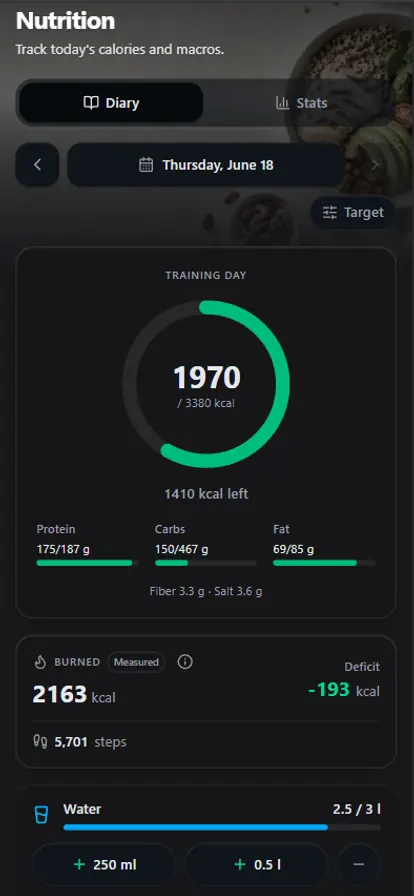
If you also want to know how much to eat, the calorie calculator works out your calorie needs and macros for your goal.
How calorie burn is calculated
MET (metabolic equivalent) tells how many times higher than resting metabolism the expenditure of an activity is. One MET is about one kilocalorie per kilogram of body weight per hour. Burn is calculated as MET × weight × time in hours: an 80 kg person burns about 360 kcal in a 45-minute vigorous gym session (MET 6).
MET values come from the Compendium of Physical Activities (Ainsworth et al. 2011), the most extensive published activity-specific collection. The values are averages: your own burn can differ by 10-20 percent with technique, intensity and fitness. The figures also include resting expenditure, so the workout's extra contribution is slightly smaller.
How to use the result
Do not eat workout calories back as such. The calorie and TDEE calculators already account for workouts at the weekly level, so a single workout's burn is not added on top. The calculator is most useful for comparing activities and for a sense of scale: an hour of walking is about 300 kcal, not a thousand.
Strength training has a low MET value, but its benefit lies in muscle mass and post-recovery expenditure, which MET does not measure. In fat loss, the calorie deficit and preserving muscle decide, not the calorie count of a single session.
Frequently asked questions
What is a MET value?
MET (metabolic equivalent of task) is the expenditure multiplier compared with resting metabolism. 1 MET is rest, about 1 kcal per kilogram per hour. Running at 10 km/h is about 9.8 MET, nearly ten times resting expenditure.
How accurate is a calorie burn calculator?
MET values are population averages, and individual burn typically differs by 10-20 percent. A heart rate monitor or watch is not fundamentally more accurate: they estimate with a formula too. The calculator is good for scale and comparing activities, not for counting calories to the gram.
How many calories does a gym workout burn?
Regular strength training is about 3.5 MET and vigorous training with short rests about 6 MET. For an 80 kg person that is 280-480 kcal per hour. The figure is lower than running, but the benefit of strength training comes from muscle mass, which MET does not measure.
Why does my watch show a different number?
Watches estimate burn from heart rate and movement with their own formula, and in research their error is similar to the MET method. In strength training especially, watches are far off because heart rate does not reflect muscular work. Use both as a guide.
Should I eat workout calories back?
Not as such. If your calorie target was calculated with workouts included, as in SisuLift's calorie calculator, the workout burn is already counted. Eating workout calories back on top cancels the deficit. The exception is a very long endurance session.
See also
- 01TDEE CalculatorCalculate your total daily energy expenditure at every activity level.
- 02Calorie CalculatorCalculate your daily calorie needs and macros based on your goal.
- 03Heart Rate Zone CalculatorMax heart rate and five zones, Karvonen formula with resting HR.
- 04Calorie Deficit CalculatorCalorie deficit, weekly rate and an estimated date for your goal weight.