

Short answer: a food diary is a record of everything you eat and drink, ideally written down right after you eat. In research, keeping a food diary consistently is linked to better weight management, and consistency matters more than precision: a rough estimate logged every day tells you more than a gram-perfect diary you abandon on day three. For most people a 2-4 week tracking period is enough to see where calories and protein really come from. Below: what to record, whether you need to weigh food, paper vs app, a free template, and what more than 72,000 foods logged in SisuLift show about where food logging usually breaks down.
Why does a food diary work? What the research says
A familiar scene: your doctor or dietitian asks you to keep a food diary for a week. Monday is meticulous, by Wednesday you are filling it in from memory at night, and Saturday stays blank. That gap is exactly what a food diary exposes: the difference between what you think you eat and what you actually eat.
A systematic review by Burke and colleagues (2011, Journal of the American Dietetic Association) covered 22 weight loss studies, 15 of them on dietary self-monitoring. The link between self-monitoring and weight loss showed up consistently, even though the quality of the studies left room for improvement. A newer review of digital self-monitoring (Patel et al. 2021, Obesity) pooled 39 randomized trials and reached the same conclusion: more self-monitoring was linked to greater weight loss in 74% of the results examined.
Frequency matters too. In the Weight Loss Maintenance trial (Hollis et al. 2008), 1,685 adults went through a six-month group program and kept food records on an average of 3.7 days a week. The more days per week they logged, the more weight they lost: each extra day per week was associated with roughly half a kilo (about a pound) of additional weight loss. Harvey and colleagues (2019, Obesity) summed it up as log often, lose more. People who lost at least 10% of their body weight did not spend more time logging than others, but they opened their food journal more often, 2.7 times a day on average versus 1.7.
Most of this research is observational, so part of the link is simply that motivated people also log more. Still, self-monitoring is the centerpiece of behavioral weight management, and in practice a food diary gives you four things:
- You see your meal rhythm: whether breakfast gets skipped and eating piles up in the evening
- You find hidden calories such as cooking oil, drinks and snacking
- You see whether your protein supports your training or falls short at breakfast and lunch
- You get a baseline to compare with a calorie calculator estimate of what you burn
What to write in a food diary
A food diary records every time you eat or drink: the time, what you had and how much. You can pick the level of detail to match your goal, and choosing a level that is too heavy is the most common reason people quit. Four options:
Four levels of detail in a food diary
| Level | What you record | Good when |
|---|---|---|
| Mapping | Time, food and estimated amount (a plate, a piece, a glass), plus hunger and situation | You want to see your meal rhythm and habits, or a health professional asked for a diary |
| Portion sizes | Amounts in cups, pieces and label values, calories and macros from an app or a food database | You want to know calories and protein for weight management |
| Grams | Everything weighed on a kitchen scale, including oil and butter | You are prepping for a competition, running a strict cut or calibrating your eye for a week |
| Protein only | Only protein sources and grams | You train, your weight is fine, but protein easily falls short |
If you train and your weight is where you want it, tracking protein alone is a surprisingly effective middle ground. Research puts a lifter's daily protein needs at roughly 1.6-2.2 grams per kilogram of body weight, and the protein calculator gives you your own number. When you want to track all macros, the macro calculator sets a target to compare your diary against.
Do you need to weigh your food?
No, at least not at first. Weighing improves accuracy, but in the research the benefit has followed how consistently people log. A good compromise is to weigh the foods you eat every day for one week, like oatmeal, rice, pasta, cheese and butter. After that your eye is calibrated and you can switch to cups, pieces and servings. Oil and butter are worth measuring with a spoon every time, because a small error there is a lot of energy.
Example day in a food diary
The notes line is often the most valuable, because it tells you why you ate, not just what. If strong afternoon hunger shows up three days a week, the fix is more likely at lunch than in willpower.
Paper, app or photo food diary?
All three work, and the best one is the one you will actually use every day. If your dietitian or doctor gave you their own form, use it: they want to see exactly that information in that format.
Paper, app and photo food diary compared
| Feature | Paper form | App | Phone photos |
|---|---|---|---|
| Getting started | ✓ Easy | ~ Install and learn | ✓ Easy |
| Calories and macros | ✕ Do the math yourself | ✓ Automatic | ✕ Only if someone estimates |
| Repeat meals | ✕ Write it out every time | ✓ Saved | ~ New photo every time |
| Forgotten entries | ✕ You notice at night | ~ Reminders help | ✓ Photo taken on the spot |
| Sharing with a professional | ✓ Bring the form | ~ Depends on the app | ~ Photos from your phone |
| Price | ✓ Free | ~ Free or subscription | ✓ Free |
The research backs the app side too. In Patel's review, people logging digitally logged more consistently than people logging on paper in 21 of 34 comparisons, and paper came out ahead in only two. Paper's strengths are zero distraction and nothing to learn.
A photo food diary is the lightest option: snap a picture before you eat and go through the day in the evening. It shows meal rhythm and portion sizes well, but it only tells you calories and protein if someone estimates them from the photos. If you prefer a browser, Finland's national food database Fineli.fi also has a free food diary tool.
Free food diary template
You don't need a special notebook. Copy this structure onto paper, into your phone's notes or into a spreadsheet:
- Header: date, training or rest day, and hours of sleep
- One line per eating occasion: time, what you ate or drank, and the amount (g, cups, pieces or a plate)
- Drinks on their own lines: milk in coffee, juice, soda, beer and wine
- Hunger before eating on a 1-5 scale and a short note on the situation (rushed, at work, on the couch)
- One line at the end of the day: what went to plan and what didn't
The template follows the same logic as our workout log template, so if you already log your training, the structure will feel familiar. One week of food diary already shows a lot, two weeks show more.
Download the free food diary template
The template is free and does not ask for your email. The printable version has a table for each day of the week. In Excel, calories and protein add up per day if you choose to fill them in.
How to keep a food diary faster
Time is the biggest enemy of food logging. In Harvey's study, logging took an average of 23 minutes a day in the first month and 15 minutes by the sixth, so it gets faster as your foods become familiar. These shortcuts get you there sooner:
- Save repeat meals. Most people eat the same breakfasts and snacks week after week. Save them once and log the whole meal in one go after that.
- Copy yesterday. If today went like yesterday, copy it and change only the differences.
- Scan barcodes. For packaged food, scanning is the fastest way to get the label values right.
- Use a national food database for home cooking. For ingredients and home-cooked food, a national food composition database beats user-submitted entries. In Finland that is Fineli, maintained by the Finnish Institute for Health and Welfare (THL), with more than 4,000 foods.
- Log right away. Three quick entries through the day are easier than one long recall in the evening, and in Harvey's study frequency is what set the successful people apart.
- Log planned meals ahead. When dinner is already logged in the morning, you see right away how much room is left in the day.
In SisuLift's data, two out of three entries are foods the same person has logged before. That is why speeding up repeat foods saves more time than any other single trick.
Common food diary mistakes
These cost you the most accuracy, and every one of them is human:
- Leaving out oil and butter. One tablespoon of rapeseed oil is about 120 kcal using Fineli's values, so the oil in the pan and the butter on your bread are the most common gap in a food diary.
- Forgetting drinks. Milk in coffee, juice, soda, beer and wine count just like food. A glass of low-fat milk (200 ml) is about 90 kcal and a 330 ml can of regular-strength lager about 140 kcal.
- Skipping weekends. Weekday routine makes logging easy, Saturday does not. If you only log weekdays, your average looks better than reality, and in SisuLift's data weekends go unlogged clearly more often than weekdays.
- Logging it later. Memory rounds down. In a study where ten adults who struggled to lose weight reported their own intake, the energy they reported was on average 47% lower than what they actually ate (Lichtman et al. 1992). It is not lying: small bites simply don't stick in memory.
- Tastes and nibbles. Tasting while cooking, finishing the kids' plates and grabbing from the office candy bowl are small on their own, but there are a lot of them.
- Logging only the good days. A bad day is the most valuable data, because it shows which situation derails the plan.
What 72,000 logged foods show about keeping a food diary
Between June and September 2026, 438 users logged more than 72,000 foods in SisuLift's food diary, covering about 4,900 days. The anonymized data shows four things worth knowing before you start:
- Two out of three entries (64%) were foods the same user had already logged on an earlier day. Diets repeat more than you would think, which is why making repeats fast matters most.
- On a typical logging day (median), people logged 15 foods across four meals. With dozens of entries a week, seconds per entry decide whether you keep going.
- Weekends stand out. Monday through Thursday, 60-62% of days were logged, Friday 56%, Saturday 49% and Sunday 50%. 62% of users logged less often on weekends than on weekdays.
- Logging fades fast. Of 227 users who started between June and mid-August, 47% were still logging in week two, 35% in week four and 25% in week six.
Share of days logged by weekday (165 users, June to September 2026)
| Weekday | Days logged |
|---|---|
| Monday | 62% |
| Tuesday | 62% |
| Wednesday | 61% |
| Thursday | 60% |
| Friday | 56% |
| Saturday | 49% |
| Sunday | 50% |
Our honest read: food diaries rarely end because they were done wrong, and most often because they feel too heavy. So decide the length of your tracking period up front, log weekends on purpose, and make repeat foods as fast as possible. These are app users, not the whole population: many tried the food diary for just a few days as part of using a training app.
How long should you keep a food diary?
For most people a 2-4 week tracking period is enough. Two weeks show your normal weekday rhythm and two weekends, four weeks also show what happens in a busy week, at parties and on training days. This is a practical rule of thumb, not a hard limit from research: in studies the benefit has followed consistency, and in SisuLift's data more than half of people are no longer logging in week two. So decide the length before you start.
After the tracking period you have three sensible options:
- Stop and keep the habits. If you now know breakfast is too small and evenings too big, fix that and only go back to logging if your weight or energy changes.
- Switch to lighter tracking. Log only protein or only weekdays, or do one logging week a month as a check-in.
- Keep going if your goal needs it. Weight loss, a cut or a bulk benefit from continuous logging, and then speed matters more than precision.
If your goal is weight loss, keep the deficit moderate. The calorie deficit calculator shows what your chosen deficit means for your timeline.
Who shouldn't keep a food diary?
A food diary is a neutral tool, but it isn't for everyone. Tracking calories can maintain or worsen eating disorder symptoms: when people diagnosed with an eating disorder were asked about a calorie tracking app, about three in four had used one, and 73% of them felt the app had contributed to their eating disorder (Levinson et al. 2017).
- If you have or have had an eating disorder, don't start tracking calories on your own. Food diaries are used in eating disorder treatment, but then the format and purpose are set by your care team.
- If logging starts causing anxiety, guilt or compulsive counting, stop and bring it up with a health professional.
- If you are pregnant or breastfeeding, or have diabetes or kidney disease, agree on energy and protein with your care team before you restrict eating based on a diary.
- Children's and teenagers' eating shouldn't be tracked as calories without professional guidance.
Food diary app: what SisuLift does
SisuLift is a training app that also has a food diary. You find it in the Nutrition tab of the bottom bar, so your workouts and your eating live in the same place. On the free plan:
- Search covers Finland's Fineli database and branded products. If something is missing, add it as your own food with the label values and it shows up in search from then on.
- Log portions in grams, deciliters, tablespoons or teaspoons. Calories, protein, carbs and fat are calculated automatically.
- Copy yesterday logs a repeat day in one go, and Your usuals adds your repeat foods in your usual amount.
- When the same meal repeats, you log it in one tap. If you eat differently on Saturdays or on training days, the app suggests that day's usual meal.
- Your calorie and macro targets are calculated from your profile, and your own foods, recipes and saved meals are in one library.
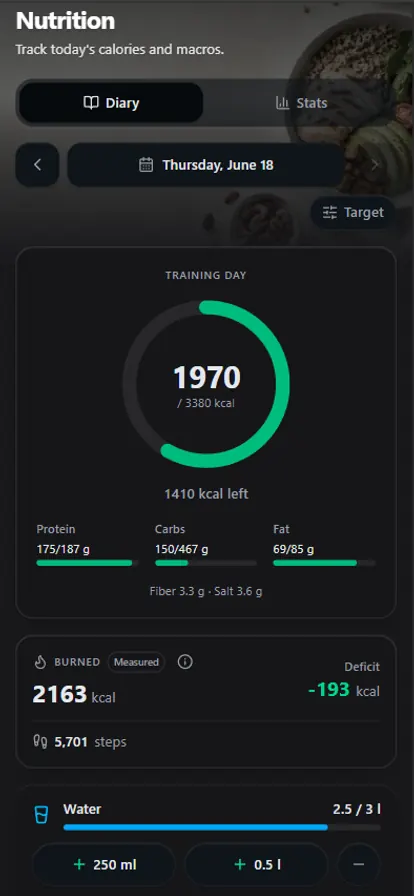
On the free plan, nutrition history goes back 7 days. Premium (€9.90/month or €79.90/year) adds barcode scanning in the mobile app, Photo a meal, which estimates foods and amounts from a picture, fiber, salt and sugar tracking, and a longer history. You can try Premium for 14 days without a credit card.
Honestly: if you only need a one-week diary for your dietitian, the printable template is enough. The app is worth it when you want calories and protein calculated or you log for longer than a couple of weeks.
Sources
- Burke LE, Wang J & Sevick MA (2011). Self-monitoring in weight loss: a systematic review of the literature. Journal of the American Dietetic Association 111:92-102.
- Hollis JF et al. (2008). Weight loss during the intensive intervention phase of the Weight-Loss Maintenance trial. American Journal of Preventive Medicine 35:118-126.
- Harvey J, Krukowski R, Priest J & West D (2019). Log often, lose more: electronic dietary self-monitoring for weight loss. Obesity 27:380-384.
- Patel ML, Wakayama LN & Bennett GG (2021). Self-monitoring via digital health in weight loss interventions: a systematic review among adults with overweight or obesity. Obesity 29:478-499.
- Lichtman SW et al. (1992). Discrepancy between self-reported and actual caloric intake and exercise in obese subjects. New England Journal of Medicine 327:1893-1898.
- Levinson CA, Fewell L & Brosof LC (2017). My Fitness Pal calorie tracker usage in the eating disorders. Eating Behaviors 27:14-16.
- Fineli, the Finnish national food composition database. Finnish Institute for Health and Welfare (THL).
- Finnish Food Authority (Ruokavirasto): Fineli, description and scope of the database (in Finnish).
→ Read also: Workout log guide | How much protein per day?