



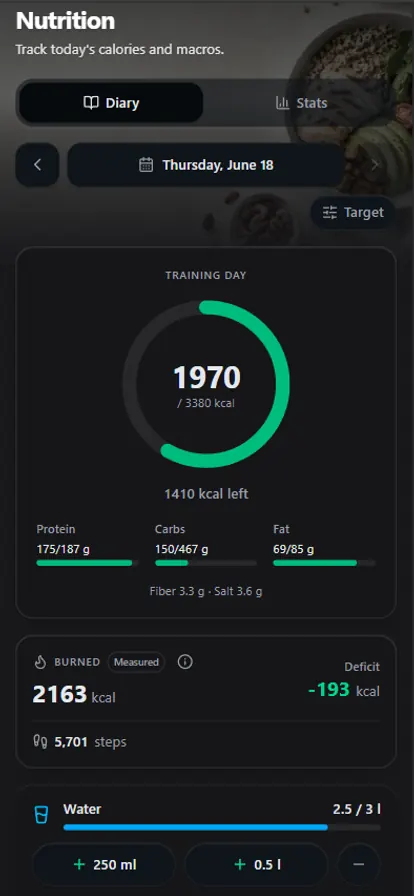
If you also want to know how much to eat, the calorie calculator works out your calorie needs and macros for your goal.
How TDEE is calculated
The base is your basal metabolic rate (BMR): the energy your body burns at rest. Daily activity is added with a multiplier and workouts as their own addition. That way a gym-goer with a desk job does not get an inflated estimate, the most common error in single-multiplier calculators.
If you provide your body fat percentage, BMR is calculated with the Katch-McArdle formula from lean body mass. Otherwise the Mifflin-St Jeor formula is used, validated in large studies.
Energy needs and energy requirement calculators: the same thing as TDEE
Energy needs is the everyday term for TDEE: how many kilocalories you need per day for your weight to stay the same. If you were looking for an energy requirement calculator, you are in the right place. The calculator splits your energy needs into three parts: basal metabolic rate, daily activity and workouts.
Nutrition guidelines often express energy needs as a physical activity level (PAL) multiplier of basal metabolic rate. This calculator does the same but treats workouts as their own multiplier, because three gym sessions a week is not the same as a physical job. That is why you pick your daily activity without counting workouts.
How to use your TDEE
TDEE is your maintenance level: eat that amount and your weight stays put. For weight loss eat about 15-20 percent below it, for muscle gain moderately above.
Remember it is an estimate. Track your weight for 2-3 weeks and adjust calories by 100-200 kcal at a time if the trend is off.
Frequently asked questions
What is TDEE?
TDEE (total daily energy expenditure) is your total daily calorie burn: basal metabolic rate plus all movement from daily steps to workouts. It is the number calorie targets are built around.
What is the difference between TDEE and BMR?
BMR is your expenditure at complete rest, TDEE your actual expenditure across the whole day. TDEE is typically 1.3-1.9 times BMR depending on activity.
Are energy needs the same thing as TDEE?
Yes. Energy needs is the plain-language name for your total daily expenditure, and TDEE is the same number as an abbreviation. This calculator is therefore also an energy requirement calculator: enter age, height, weight and activity and you get your energy needs in kilocalories instantly.
How accurate is a TDEE calculator?
A formula-based estimate lands within about 10 percent for most people. Your true expenditure shows itself when you track your weight for a couple of weeks at a steady calorie intake and adjust from there.
How far below or above TDEE should I eat?
For weight loss about 15-20 percent below, which for most people is 300-500 kcal. For muscle gain a moderate 5-10 percent surplus is enough; a large surplus mostly turns into fat.
Which activity level should I choose?
Choose the level based on your daily life alone and leave workouts out, the calculator asks about them separately. Someone with a desk job usually picks one of the two lowest levels even if they lift four times a week.
See also
- 01Calorie CalculatorCalculate your daily calorie needs and macros based on your goal.
- 02Calorie Deficit CalculatorCalorie deficit, weekly rate and an estimated date for your goal weight.
- 03Calorie Burn CalculatorHow much does the gym, a run or skiing burn? About 30 activities with MET values.
- 04Macro CalculatorCalculate your protein, carbs and fat based on your goal.