



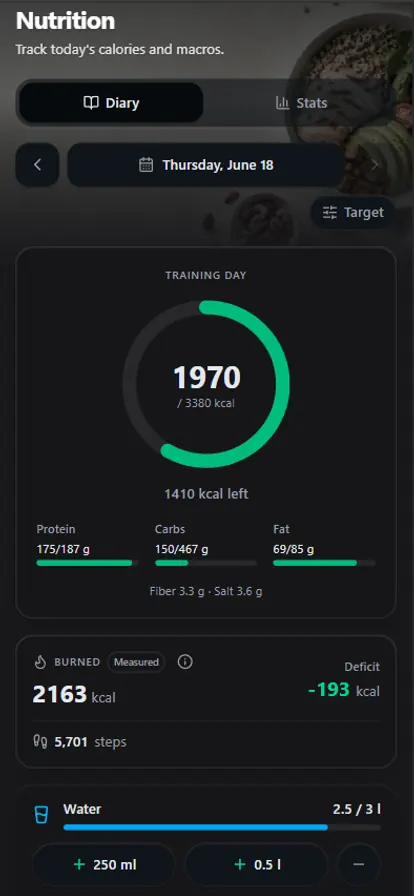
Want your maintenance calories and macros without a deficit first? The calorie calculator works them out with the same engine.
How the calorie deficit is calculated
The calculator first estimates your total expenditure, TDEE, with the same engine as the calorie calculator: basal metabolic rate with the Mifflin-St Jeor or Katch-McArdle formula, plus daily activity and workouts. The calorie deficit is subtracted from that number, and the result is your daily calorie target.
Weekly weight loss uses the 7,700 kilocalorie rule: one kilogram of fat tissue equals roughly 7,700 kcal. A 500 kcal daily deficit is 3,500 kcal a week, or about 0.45 kg. The rule is a simplification, but accurate enough for planning.
How big a calorie deficit to choose
For most people a 300-500 kcal deficit is the best compromise: 0.3-0.5 kg a week, hunger stays manageable and muscle is preserved as long as protein is sufficient and training continues. A fast 750 kcal deficit suits short blocks from a high starting weight, but it eats more easily into muscle and energy.
The calculator warns if the calorie target would fall below 1,200 kcal for women or 1,500 kcal for men. At that level it is hard to guarantee enough micronutrients, and it should not be done without professional guidance. A smaller deficit plus more movement is the better answer.
How to use the result
Eat to the calorie target for 2-3 weeks and weigh yourself in the morning at the same time. If your weekly average drops at roughly the calculated rate, the calculator was right. If not, adjust by 100-200 kcal at a time. Day-to-day swings are water, not fat.
The estimated date is indicative. Expenditure falls as weight drops, so the same deficit produces less toward the end. That is why SisuLift recalculates the target as your weight changes instead of leaving the number at its first value.
Frequently asked questions
How big a calorie deficit is right?
For most people 300-500 kcal per day, about 15-20 percent of expenditure. That loses 0.3-0.5 kg a week without hurting muscle or energy. Use a larger deficit only for short periods and from a high starting weight.
How fast do you lose weight in a calorie deficit?
A 500 kcal daily deficit means about 0.45 kg a week by the 7,700 kcal per kilogram rule. The first week often drops more because of water and glycogen, and the rate slows toward the end because a smaller body burns less.
Can I eat under 1,200 calories a day?
Not without guidance from a doctor or dietitian. Under 1,200 kcal for women and 1,500 kcal for men it is hard to get enough protein, fiber and micronutrients, and muscle starts to suffer. The calculator shows a warning if the target would fall below these limits.
Why is my weight not dropping in a calorie deficit?
The most common reasons are unlogged eating, overestimated expenditure and water fluctuation. Track the weekly average, not single days. If the average has not moved in three weeks, cut the calorie target by 100-200 kcal or add steps. The calculator's expenditure estimate is a starting point, not the truth.
How much protein in a calorie deficit?
About 2.0-2.4 g per kilogram of body weight, more than at maintenance. High protein preserves muscle and keeps hunger away. The protein calculator gives an exact gram amount for your weight.
See also
- 01Calorie CalculatorCalculate your daily calorie needs and macros based on your goal.
- 02TDEE CalculatorCalculate your total daily energy expenditure at every activity level.
- 03Ideal Weight CalculatorFour formulas and the BMI range by height, with honest caveats.
- 04Protein CalculatorHow much protein do you need per day? Recommendation and range.
- 05BMI calculatorBody mass index, BMI category and the waist-to-height ratio that tells a lifter more.