



How the calorie calculator works
The calculator first estimates your basal metabolic rate, the energy your body burns at rest. If you provide your body fat percentage, it uses the Katch-McArdle formula which accounts for body composition. Otherwise it uses the Mifflin-St Jeor formula, recommended by the Academy of Nutrition and Dietetics.
Daily activity and workouts are added on top separately. Most calculators bundle these into one activity multiplier, which easily overestimates the needs of a gym-goer with a desk job. Here workouts are asked as their own question, so nothing gets counted twice.
Finally your goal adjusts the total: weight loss cuts calories by about 20 percent, maintenance stays at your expenditure, and muscle gain adds a moderate surplus.
Calorie needs by goal
For weight loss the calculator sets a deficit of about 20 percent. For most people that means losing 0.25-0.5 kg per week, a pace that preserves muscle and keeps hunger manageable. Protein is raised to 2.2 grams per kilo of body weight at the same time.
For muscle gain the surplus is moderate, about 6-12 percent depending on experience level. A big surplus does not speed up muscle growth, it just becomes fat. If your body fat is high, the calculator steers you to a slight deficit where muscle grows and fat burns at the same time.
Calorie needs, calorie intake and calorie burn from one calculator
A calorie needs calculator, calorie intake calculator and calorie burn calculator all mean the same thing in practice: how many calories your body needs per day. This calculator gives you all three numbers at once. Basal metabolic rate is your expenditure at rest, maintenance calories or TDEE is your full-day expenditure, and the calorie target is the amount that gets you to your goal.
If you want to know how much a single workout or run burns, use the calorie burn calculator. It calculates expenditure by activity with MET values based on weight and duration, and the result is easy to compare with this calculator's daily figure.
How to use your result
Your calorie target is a starting point, not the final truth. Eat according to the target for 2-3 weeks and track your weight. If it is not moving in the right direction, adjust by about 100-200 kcal at a time.
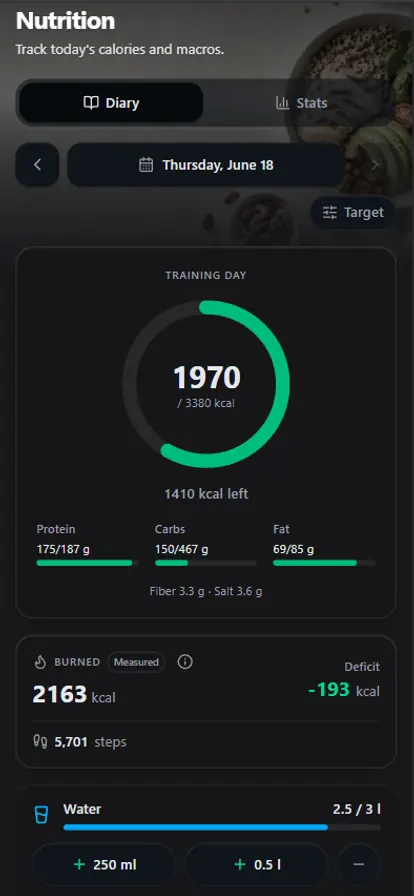
The easiest way to stay on target is to log your meals. SisuLift calculates the same target automatically and refines it based on your actual progress.
Frequently asked questions
How many calories should I eat per day?
It depends on your size, activity and goal. The calculator gives a personal estimate based on these. For most adults the need falls between 1800 and 3000 kcal.
What is BMR or basal metabolic rate?
BMR is the energy your body burns at complete rest for vital functions like breathing and circulation. It usually makes up 60-75 percent of your total daily expenditure.
Which formula does the calorie calculator use?
If you provide your body fat percentage, it uses the Katch-McArdle formula which calculates expenditure from lean body mass. Otherwise it uses Mifflin-St Jeor. Both are validated in research.
How big a calorie deficit do I need to lose weight?
The calculator uses a deficit of about 20 percent, which typically means losing 0.25-0.5 kg per week. A bigger deficit drops weight faster but easily costs muscle and is harder to stick to.
How accurate is a calorie calculator?
No calculator is perfect, since individual differences in expenditure are around 10 percent. Use the result as a starting point and adjust it after a couple of weeks of tracking.
How much protein should I eat per day?
For someone who trains, 1.6-2.2 grams per kilo of body weight is enough for muscle growth according to research. The calculator uses 2.0-2.2 g/kg depending on your goal, with more during weight loss to protect muscle.
What is the best free calorie calculator?
A good free calorie calculator separates daily activity from workouts and accounts for body composition when body fat percentage is known. This calculator does both, with no sign-up or payment required.
Can I use a food database to count calories?
Food databases like Fineli show the nutritional values of individual foods, but they do not calculate your daily calorie needs. For that you need a calculator like this one, and for tracking an app with a built-in food database.
How do I calculate how many calories I burn?
That is exactly what this calculator does: your maintenance calories, or TDEE, are your total daily expenditure. It includes your basal metabolic rate, daily activity and workouts. A single workout typically burns 200-500 kcal, a smaller share of the total than many assume.
How do I use the calorie calculator for weight loss?
Choose weight loss as your goal and the calculator sets a deficit of about 20 percent below your maintenance calories. Eat to the target and weigh yourself weekly: a good pace is 0.25-0.5 kg per week.
See also
- 01TDEE CalculatorCalculate your total daily energy expenditure at every activity level.
- 02Calorie Deficit CalculatorCalorie deficit, weekly rate and an estimated date for your goal weight.
- 03Macro CalculatorCalculate your protein, carbs and fat based on your goal.
- 04Calorie Burn CalculatorHow much does the gym, a run or skiing burn? About 30 activities with MET values.