



Checked 2 Sep 2026
Wide shoulders give the body its V-shape and are usually the part that separates a trained upper body from an untrained one. Still, shoulder training is lopsided for many: the overhead press and bench take care of the front delt, lateral raises are done by swinging, and the rear delt is forgotten entirely. This guide covers the three heads of the deltoid, 10 exercises with exercise library links, two ready-made sessions and a volume recommendation for shoulders that grow in balance and stay healthy.
The three heads of the shoulder
The deltoid is divided into three heads with different jobs. The front delt raises the arm forward and takes part in every press. The side delt raises the arm to the side and gives the shoulders their width. The rear delt pulls the arm back and rotates the upper arm outward, and it works in rowing movements together with the upper back.
Besides the three heads, shoulder function depends on the rotator cuff, a group of four small muscles that keep the head of the humerus in its socket. It does not show on the outside, but without it a heavy press is not safe. That is why a good shoulder workout always includes a pulling movement that strengthens the rear delt and the rotator cuff at the same time.
Why the rear delt stays weak
The front delt gets work from every bench press, incline press, overhead press and dip. In a typical programme it accumulates 15 to 25 sets a week without a single dedicated front delt exercise. The side delt gets work from the overhead press and lateral raises. The rear delt only gets work from rows, and even there the upper back does most of the job.
The result is familiar: shoulders rounded forward, a pinched feeling in the shoulder during heavy presses, and shoulders that look big from the front but thin from the side. The rear delt is also hard to feel because you cannot see it in the mirror, and the exercise is often done with too much weight, so the traps and upper back take over.
The fix is simple: 2 to 3 rear delt exercises a week with light weight and slow tempo, 12 to 20 reps, so that the movement is felt in the back of the shoulder and not in the shoulder blades. The face pull and the reverse fly are best for this, because they are hard to cheat.
10 shoulder exercises with exercise library links
The exercises are divided into three groups. Each has an animation and technique guide in the exercise library. The tip in each row fixes the most common mistake.
Presses and the front delt
- Standing barbell overhead press: The foundation of shoulder training and the measure of strength. Glutes and abs tight, the bar travels straight up past the head, not in an arc. This takes care of the front delt; a separate front raise is not needed.
- Seated dumbbell shoulder press: Allows a natural arm angle and evens out side-to-side differences. Elbows slightly in front of the body, not directly out to the sides.
- Arnold press: The rotation at the bottom gives the front delt a longer range of motion. Lighter weight than a regular press, controlled tempo.
Side delt
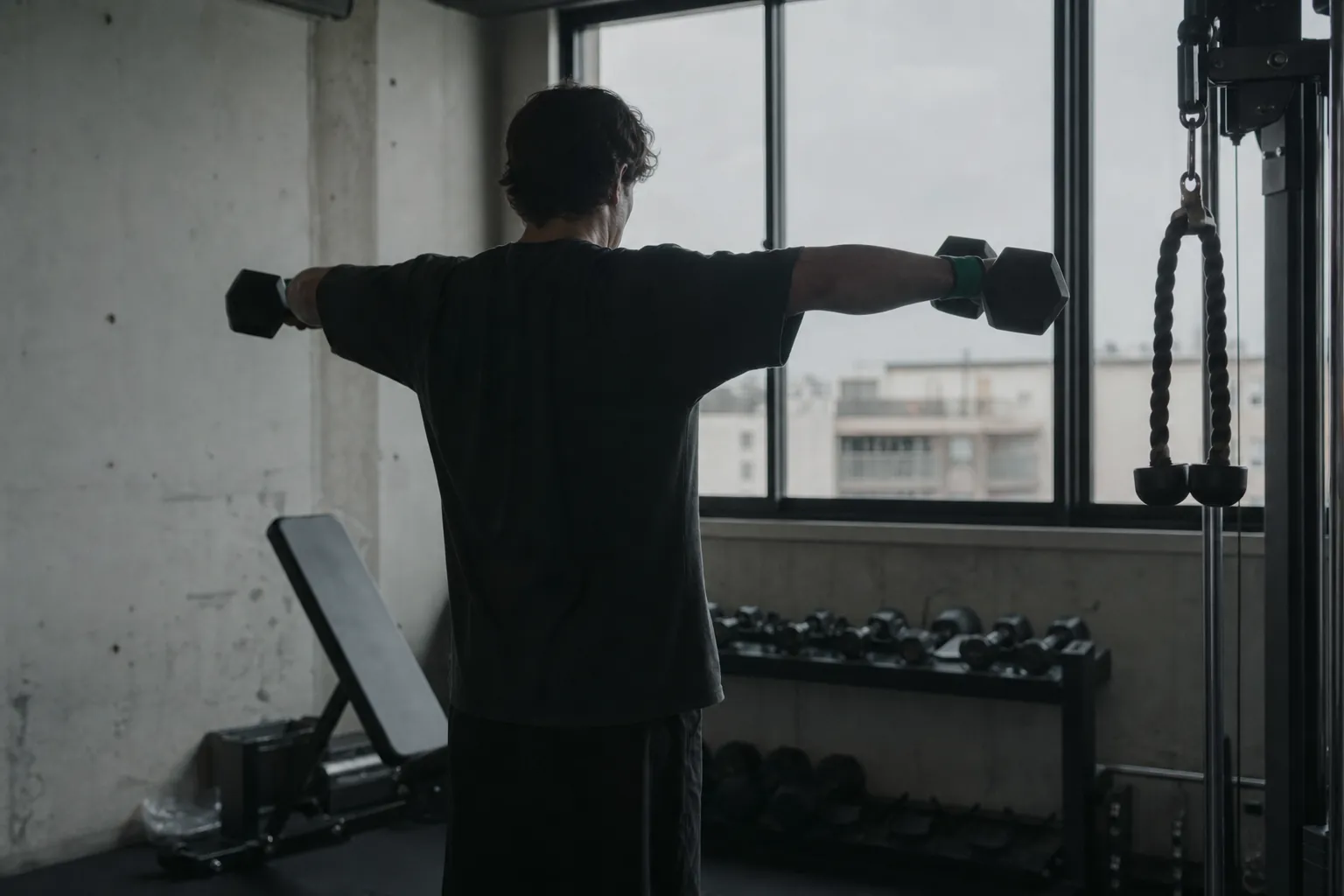
- Dumbbell lateral raise: The most important side delt exercise. The elbow leads, little finger slightly up, stop at shoulder height. If you swing with the body, the weight is too heavy.
- Cable lateral raise: The cable keeps the resistance even through the whole range, including at the bottom where a dumbbell is light. Good as the first side exercise.
- Machine lateral raise: Easiest to load heavy and take to the end, because balance does not need to be controlled. Suits the last set where you go close to failure.
Rear delt
- Face pull: Pull the rope toward the face, elbows high, rotate the hands outward at the end. Rear delt and rotator cuff at the same time. Light weight, 15 to 20 reps.
- Seated machine reverse fly: Arms almost straight, the movement comes from the shoulder and not from squeezing the shoulder blades together. Pause briefly at the back.
- Dumbbell rear delt fly: Torso nearly horizontal, light weights, elbows slightly bent. The most common mistake is too much weight and swinging the upper body.
- Cable rear delt row: Elbows high and wide, pull toward the neck. A heavier option for the rear delt once the flies are done.
2 ready-made shoulder workouts
Workout A is a full shoulder day that can be done once a week instead of or in addition to a push day. Workout B is a 20-minute add-on placed at the end of a pull day that hits the side and rear delts a second time in the week. Together they produce about 16 sets a week, weighted toward the side and rear.
Workout A: shoulder day (45 min)
Start with the heavy press while you are fresh, then move to isolation exercises. Rest 2 to 3 minutes on presses, 60 to 90 seconds on isolation work. Target 1 to 3 reps in reserve.
Workout A: shoulder day
| Exercise | Sets | Reps | Rest |
|---|---|---|---|
| Standing barbell overhead press | 4 | 5-8 | 2-3 min |
| Seated dumbbell shoulder press | 3 | 8-12 | 90 s |
| Cable lateral raise | 3 | 12-15 | 60 s |
| Dumbbell lateral raise | 2 | 15-20 | 60 s |
| Face pull | 3 | 15-20 | 60 s |
| Seated machine reverse fly | 3 | 12-15 | 60 s |
Workout B: side and rear, 20-minute add-on
Done at the end of a pull day or as its own short session 2 to 3 days after workout A. Light weights, slow tempo, feel it in the side and back of the shoulder.
Workout B: side and rear delts
| Exercise | Sets | Reps | Rest |
|---|---|---|---|
| Cable rear delt row | 3 | 10-12 | 60-90 s |
| Dumbbell rear delt fly | 3 | 12-15 | 60 s |
| Machine lateral raise | 3 | 12-15 | 60 s |
| Dumbbell lateral raise, slow 3 s lowering | 2 | 12-15 | 60 s |
| Face pull | 2 | 15-20 | 45 s |
How much volume do shoulders need?
The meta-analysis by Schoenfeld, Ogborn and Krieger (2017) found that at least 10 working sets a week per muscle group produced more muscle growth than fewer than 5, and the benefit grew with volume up to a reasonable limit. The special feature of the shoulders is that the front delt gets a large share of its volume from presses, so dedicated volume should go to the side and rear.
Weekly volume for shoulders (working sets per head, presses counted toward the front delt)
| Level | Front delt | Side delt | Rear delt | Note |
|---|---|---|---|---|
| Beginner | Bench and overhead press are enough | 4-6 | 4-6 | Two sessions a week, light weights, technique |
| Intermediate | Presses + 0-3 extra sets | 8-12 | 8-12 | Side and rear as their own exercises twice a week |
| Advanced | Presses + 0-4 | 12-16 | 12-16 | Raise volume by 1-2 sets a week during the mesocycle, deload at the end |
Frequency determines how much volume you can tolerate: the review by Schoenfeld, Grgic and Krieger (2019) found that the same weekly volume produces similar growth whether split into one or several sessions, but 12 to 16 sets are easier to do well in two sessions than in one. That is why workouts A and B are on different days.
Progression is the same as for other muscles: when the top of the rep range is reached in all sets, increase the weight. In lateral and rear raises the weight step is small, often 1 to 2 kg, so adding reps from 12 up to 20 before increasing the weight is a good approach. SisuLift's weekly progression suggests this automatically and knows the weight increments of the machines.
Shoulder pain: what to keep in mind
The shoulder is the body's most mobile and therefore most sensitive joint. This article is not medical advice, and if your shoulder hurts, the right place is a physiotherapist or doctor, not harder training. A few signs when training should be stopped and help sought:
- Sharp pain inside or at the front of the joint during a press that does not ease with lighter weight.
- Pain that wakes you at night or stops you sleeping on your side.
- A sudden loss of strength or a feeling that the shoulder "gives way" during a movement.
- Numbness or tingling in the arm or fingers.
- Pain that continues for more than 2 weeks despite lighter training.
A common, non-medical observation is that much shoulder irritation in lifters relates to imbalance: a lot of pressing, little pulling and rear delt work. That is why the workouts in this article have at least as many pulling or rear delt sets as pressing sets. It does not heal an injury, but it is a good starting point for a healthy shoulder. Always warm up with light face pulls or band rotations before heavy pressing.
When you want shoulders as part of the whole programme
A dedicated shoulder day works if the rest of the week is in order. For most people the better solution is a programme where the shoulders get their volume inside push and pull days twice a week. SisuLift's free workout programmes (2-, 3- and 4-day splits) include side and rear delt exercises by default, and the app handles progression.
→ Free workout programmes: 2-, 3- and 4-day splits
Sources
- Schoenfeld BJ, Ogborn D, Krieger JW. Dose-response relationship between weekly resistance training volume and increases in muscle mass: a systematic review and meta-analysis. Journal of Sports Sciences 2017.
- Schoenfeld BJ, Grgic J, Krieger J. How many times per week should a muscle be trained to maximize muscle hypertrophy? A systematic review and meta-analysis. Journal of Sports Sciences 2019.
- Baz-Valle E, Balsalobre-Fernández C, Alix-Fages C, Santos-Concejero J. A systematic review of the effects of different resistance training volumes on muscle hypertrophy. Journal of Human Kinetics 2022.
- Botton CE et al. Electromyographical analysis of the deltoid between different strength training exercises. Medicina Sportiva 2013.
→ Read also: Ab workout, 10 exercises | Beginner gym programme, 8 weeks | Workout log: how to track progress