



Checked 2 Sep 2026
Ab training is the most common misunderstanding in the sport. Hundreds of crunches a day will not bring visible abs if body fat is too high, and on the other hand dieting alone without training reveals a thin stomach with no shape. An effective ab workout is like any other muscle training: a few good exercises, load that grows and 2 to 3 sessions a week. This guide has the anatomy in brief, 10 exercises with exercise library links and three ready-made sessions as tables.
Core anatomy in brief
The rectus abdominis runs from the sternum to the pubic bone and flexes the trunk forward. It is the muscle whose tendinous intersections form the so-called six-pack. Crunches, leg raises and rollouts load it.
The obliques (external and internal) run diagonally along the sides and rotate and bend the trunk sideways. They also resist rotation, which matters in lifts. Side planks, cable rotations and the Pallof press load them.
The transversus abdominis is the deepest layer and works like a natural lifting belt: it tightens the abdominal cavity and supports the lower back. It activates strongly in heavy compound lifts such as the squat and deadlift, and in exercises where the trunk is held still against load, such as the plank and dead bug. That is why a good core workout includes both movement and holds.
Why body fat percentage decides visibility
Almost everyone has abs and they can be trained, but they are covered by subcutaneous fat. In men the outline of the abs generally starts to show at around 12 to 15 % body fat and clearly at around 10 %; in women at around 18 to 22 % and clearly at around 16 %. These are general rules of thumb, because fat distribution is individual and genetic.
In practice this means ab training and fat loss are two separate projects. Training builds muscle and shape, an energy deficit reveals it. In research, ab exercise alone without an energy deficit did not reduce abdominal fat (Vispute et al. 2011). You can estimate your starting point with a body fat calculator, and SisuLift's food diary with Fineli search helps keep the deficit moderate, about 300 to 500 kcal a day, so that muscle is preserved.
→ Body fat calculator: estimate your starting point
The 10 best ab exercises
The exercises are chosen to cover all three jobs: flexion, rotation and anti-rotation, and holds. Each has an animation and technique guide in the exercise library. The tip in each row fixes the most common mistake.
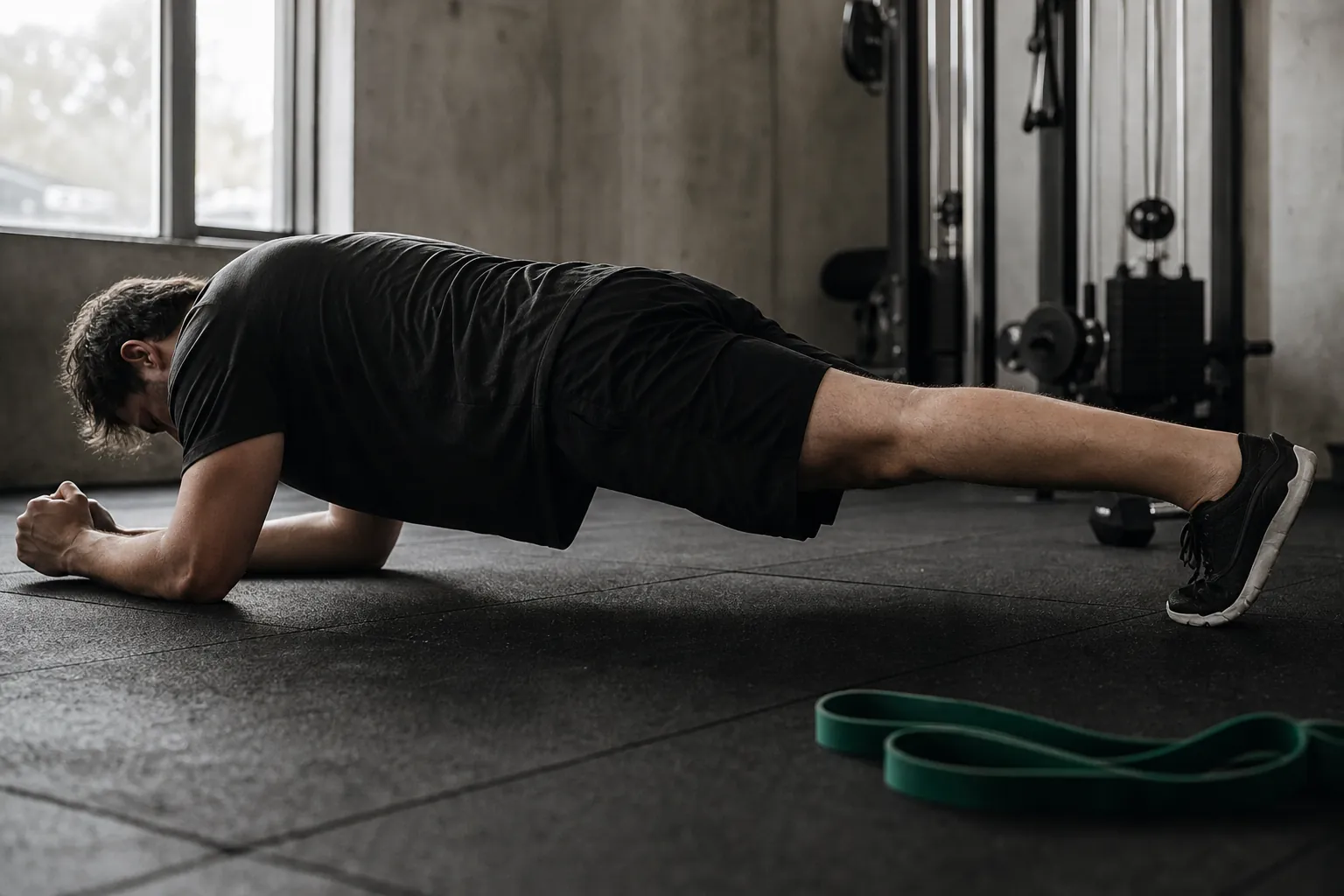
- Plank: Squeeze the glutes and pull the navel toward the spine. A clean 20 to 45 second hold beats 2 minutes with a sagging lower back.
- Dead bug: The lower back stays on the floor for the whole movement. If it lifts, shorten the leg extension.
- Side plank: Hips up and in line, body straight as a board. Obliques and lateral core support.
- Bird dog: Opposite arm and leg extend slowly, the pelvis does not rotate. Deep muscle and lower back support.
- Bicycle crunch: Elbow toward the opposite knee by rotating the trunk, not by yanking the neck. Slow tempo.
- Hanging leg raise: Tilt the pelvis up at the end of the movement, otherwise the hip flexors do the work. Start with bent knees.
- Cable crunch: The one exercise where abs are easy to load progressively. Round the spine, do not hinge at the hips.
- Kneeling ab wheel rollout: Roll only as far as the lower back stays neutral. The heaviest bodyweight exercise for the rectus abdominis.
- Cable Pallof press: Press the handle forward and keep the trunk from rotating. Trains anti-rotation, which the squat and deadlift demand.
- Cable twist: The rotation comes from the thoracic spine and hips together, arms stay straight. Obliques under load.
If you have to pick three, choose the cable crunch (flexion under load), the Pallof press (anti-rotation) and the plank or dead bug (hold). They cover all three jobs and progression is easy: add weight, reps or hold time.
3 ready-made ab workouts
Each session takes 10 to 15 minutes and is done 2 to 3 times a week, for example at the end of a gym session or as its own short session. Rest 45 to 60 seconds between sets. The target is 1 to 3 reps in reserve, not total exhaustion.
Workout 1: home, no equipment (10 min)
Suits beginners and home trainers. Progression: lengthen holds by 5 seconds a week and add reps when 15 feels easy.
Workout 1: home
| Exercise | Sets | Reps or time | Rest |
|---|---|---|---|
| Dead bug | 3 | 10 per side | 45 s |
| Plank | 3 | 30-45 s | 45 s |
| Bicycle crunch | 3 | 12-15 per side | 45 s |
| Side plank | 2 | 20-30 s per side | 45 s |
| Bird dog | 2 | 8 per side, 3 s hold | 45 s |
Workout 2: gym, cable and added weight (15 min)
Abs are loaded like any other muscle. When the top of the rep range is reached in all sets, move the cable stack up one pin.
Workout 2: gym
| Exercise | Sets | Reps | Rest |
|---|---|---|---|
| Cable crunch | 3 | 10-15 | 60 s |
| Hanging leg raise (bent knees or straight legs) | 3 | 8-12 | 60 s |
| Cable Pallof press | 3 | 10 per side | 45 s |
| Cable twist | 2 | 10-12 per side | 45 s |
| Weighted plank | 2 | 30-40 s | 60 s |
Workout 3: advanced (15 min)
Requires a clean 60-second plank and 12 hanging knee raises. The exercises are heavy and the tempo slow.
Workout 3: advanced
| Exercise | Sets | Reps | Rest |
|---|---|---|---|
| Kneeling ab wheel rollout | 4 | 8-12 | 60 s |
| Hanging straight-leg raise | 4 | 8-12 | 60 s |
| Cable crunch, slow 3 s lowering | 3 | 10-12 | 60 s |
| Cable Pallof press, 2 s hold | 3 | 8 per side | 45 s |
| Side plank with leg lift | 3 | 20 s per side | 45 s |
How often should you train abs?
Abs recover like other muscles, so 2 to 3 sessions a week is a good amount and 6 to 12 working sets a week a sufficient starting point. Training every day does not speed up results, because muscle grows during rest. The exception is light activation in the warm-up, for example a dead bug or plank before squats, which is not a real session.
Remember that the squat, deadlift, overhead press and farmers walk already load the core on their own. If your programme has these 2 to 3 times a week, a separate ab session is an addition, not the foundation. SisuLift's weekly progression counts ab volume from these lifts as well.
Ab myths you can forget
- "Crunches burn belly fat." Fat cannot be burned locally. In several studies (e.g. Vispute et al. 2011, Ramírez-Campillo et al. 2013) fat in the trained area did not decrease more than elsewhere. Fat decreases across the whole body through an energy deficit.
- "Abs must be trained every day." They are muscles like any other and need recovery. 2 to 3 times a week with load produces more than 7 times lightly.
- "Upper and lower abs are trained with different exercises." The rectus abdominis is one muscle. Leg raises emphasise the lower part slightly and crunches the upper part, but both activate the whole muscle. Do both, do not worry about the split.
- "A six-pack is made in the gym." Shape is made in the gym, visibility in the kitchen. Without a low enough body fat percentage the muscle does not show, even if it is strong.
- "Hundreds of reps beat weights." The abs respond to load like the biceps. 10 to 15 reps on the cable with a weight that leaves 1 to 3 reps in reserve builds muscle better than 100 light crunches.
When you want the whole programme
This article gives the exercises and three sessions. If you want the core as part of a full weekly programme, balanced with the rest of your training, SisuLift's free core workout programme does that for you with three training days a week and progression that raises the load when the reps fill up.
→ Core workout programme: 3 days a week
Sources
- Vispute SS, Smith JD, LeCheminant JD, Hurley KS. The effect of abdominal exercise on abdominal fat. Journal of Strength and Conditioning Research 2011.
- Schoenfeld BJ, Ogborn D, Krieger JW. Dose-response relationship between weekly resistance training volume and increases in muscle mass. Journal of Sports Sciences 2017.
- Ramírez-Campillo R et al. Regional fat changes induced by localized muscle endurance resistance training. Journal of Strength and Conditioning Research 2013.
- Escamilla RF et al. Core muscle activation during Swiss ball and traditional abdominal exercises. Journal of Orthopaedic and Sports Physical Therapy 2010.
→ Read also: Shoulder workout, 10 exercises | HIIT workout, 5 ready-made sessions | Beginner gym programme, 8 weeks