



Who this program suits
This template suits someone with experience in basic strength exercises and easy running. It provides a four-session weekly structure. Preparation time depends on your starting point, division and recovery; 12 weeks does not guarantee race readiness.
Two running exposures come from the easy run and the combination session. All eight stations alternate through A and B sessions and come together in week 9’s simulation.
Who this is not for
- If you have never trained at a gym: do the beginner gym program first, HYROX stations are endurance versions of strength exercises.
- If 30 minutes of easy running or run–walking is a new load, build your base first and postpone starting the plan.
- Pro-division athletes: this program is sized for a first race in the Open division.
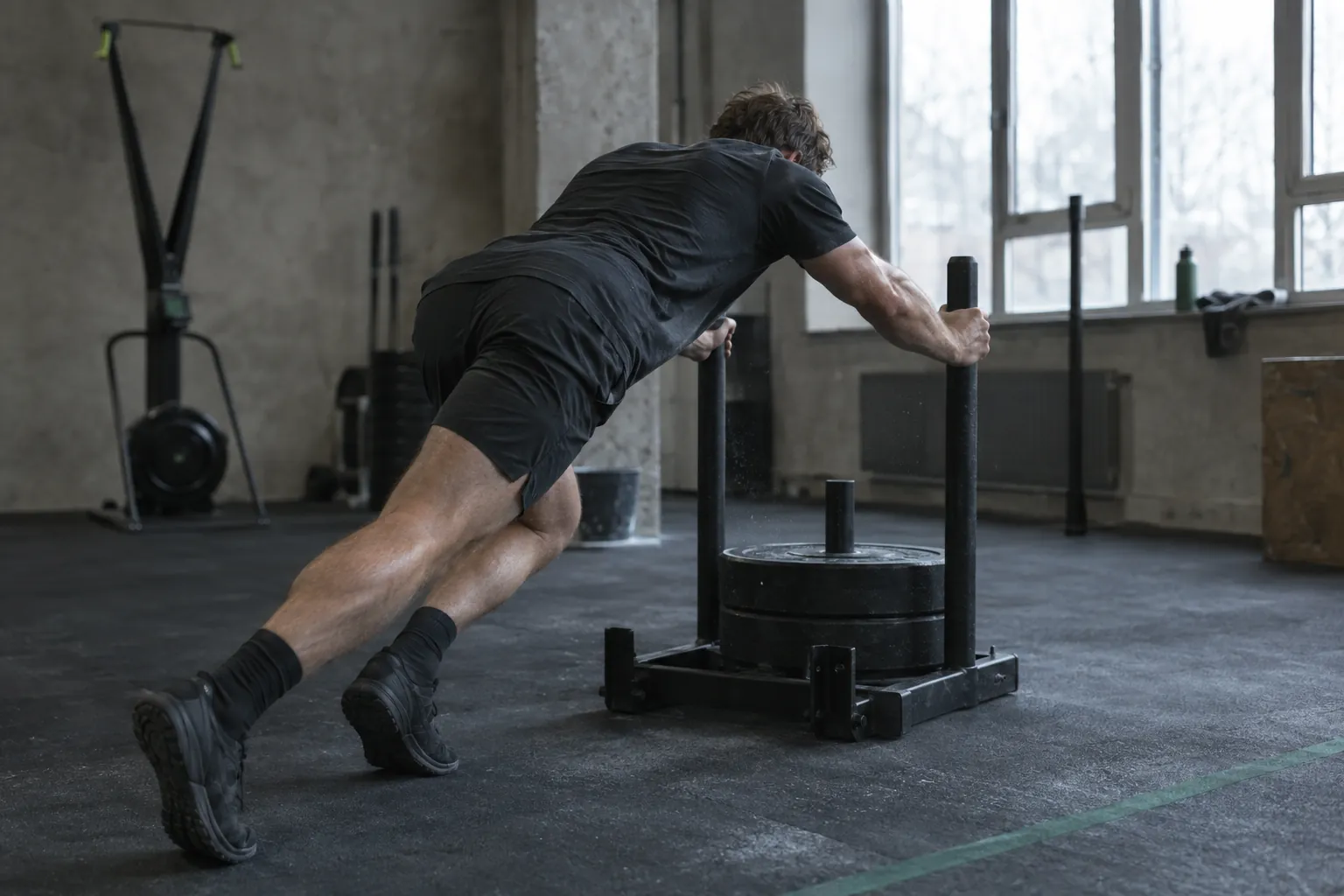
Continue with: HYROX stations: all 8 events and 26/27 weights and HYROX target time: running, stations and transitions.
HYROX training plan, week by week
Weeks 1–11 contain four sessions: strength A, an easy run, strength B and a run–station combination. Weeks 4 and 8 reduce the load. Week 9 has a half-distance simulation, week 11 tapers, and week 12 has three short activations plus the race. Shift the days to match your start date.
| Week and focus | Each strength session | Easy run | Combination session | Weekly running volume |
|---|---|---|---|---|
| 1. Technique A | 2 sets/exercise, RIR 4 | 30 min, RPE 3–4/10 | A: SkiErg, push, burpees and row: 4 × 400 m + half station distances/repetitions. RPE 5–6/10. Recovery between blocks 120 s. 40–55 min. | 30 min + 1.6 km |
| 2. Technique B | 3 sets/exercise, RIR 3 | 35 min, RPE 3–4/10 | B: pull, carry, lunges and wall balls: 4 × 400 m + half station distances/repetitions. RPE 5–6/10. Recovery between blocks 120 s. 40–55 min. | 35 min + 1.6 km |
| 3. Rhythm | 3 sets/exercise, RIR 3 | 40 min, RPE 3–4/10 | A: SkiErg, push, burpees and row: 4 × 500 m + half station distances/repetitions. RPE 6/10. Recovery between blocks 120 s. 45–60 min. | 40 min + 2 km |
| 4. Deload | 2 sets/exercise, RIR 4 | 30 min, RPE 3–4/10 | B: pull, carry, lunges and wall balls: 4 × 300 m + half station distances/repetitions. RPE 5/10. Recovery between blocks 120 s. 35–50 min. | 30 min + 1.2 km |
| 5. Build A | 3 sets/exercise, RIR 3 | 45 min, RPE 3–4/10 | A: SkiErg, push, burpees and row: 4 × 600 m + half station distances/repetitions. RPE 6–7/10. Recovery between blocks 90 s. 45–65 min. | 45 min + 2.4 km |
| 6. Build B | 3 sets/exercise, RIR 3 | 50 min, RPE 3–4/10 | B: pull, carry, lunges and wall balls: 4 × 600 m + half station distances/repetitions. RPE 6–7/10. Recovery between blocks 90 s. 45–65 min. | 50 min + 2.4 km |
| 7. Longer runs | 3 sets/exercise, RIR 2 | 55 min, RPE 3–4/10 | A: SkiErg, push, burpees and row: 4 × 800 m + half station distances/repetitions. RPE 7/10. Recovery between blocks 90 s. 50–70 min. | 55 min + 3.2 km |
| 8. Deload | 2 sets/exercise, RIR 4 | 40 min, RPE 3–4/10 | B: pull, carry, lunges and wall balls: 4 × 400 m + half station distances/repetitions. RPE 5–6/10. Recovery between blocks 120 s. 40–55 min. | 40 min + 1.6 km |
| 9. Half simulation | 2 sets/exercise, RIR 3 | 45 min, RPE 3–4/10 | Simulation: all 8 stations: 8 × 500 m + half station distances/repetitions. RPE 7/10. Recovery between blocks 60 s. 65–90 min. | 45 min + 4 km |
| 10. Kilometre runs | 2 sets/exercise, RIR 3 | 45 min, RPE 3–4/10 | B: pull, carry, lunges and wall balls: 4 × 1000 m + half station distances/repetitions. RPE 7/10. Recovery between blocks 90 s. 55–75 min. | 45 min + 4 km |
| 11. Taper | 2 sets/exercise, RIR 4 | 30 min, RPE 3–4/10 | Short: SkiErg, push and row: 3 × 600 m + half station distances/repetitions. RPE 5–6/10. Recovery between blocks 120 s. 30–45 min. | 30 min + 1.8 km |
| 12. Race week | No loaded strength sessions | 20 + 15 min easy running | 10–20 min easy activation, then the race on a separate day | 35 min + the race’s 8 km; no running in the activation |
Running volume lists easy-run minutes and combination kilometres separately. Convert the easy run to distance using your actual pace. Session durations are estimates, not targets. Warm up and cool down by walking or easy cycling, so there is no hidden running mileage.
Example week: week 5, four sessions
| Day | Session | Prescription | Duration |
|---|---|---|---|
| Mon | Strength A | 3 sets/exercise, RIR 3 | 45–60 min |
| Tue | Easy run | Conversational effort, RPE 3–4/10 | 45 min |
| Wed | Rest | – | – |
| Thu | Strength B | 3 sets/exercise, RIR 3 | 45–60 min |
| Fri | Rest | – | – |
| Sat | Run + stations | 600 m run + SkiErg 500 m → 600 m run + Sled push 25 m → 600 m run + Burpee broad jumps 40 m → 600 m run + Rowing 500 m. One pass; total running 2.4 km. Rest after each station 90 s. RPE 6–7/10. | 45–65 min |
| Sun | Rest or optional easy walk | No fifth demanding session | 0–30 min |
Sunday’s optional walk is everyday activity, not a fifth run or strength workout. Move sessions if needed, keeping a recovery day between strength B and the combination.
Strength sessions A and B
Take sets and RIR from the weekly table. Start each exercise with light warm-up sets. The main lifts are not max attempts. Keep carries and holds at a controlled RPE 5–7/10.
Strength A: legs and pull
| Exercise | Sets | Reps | Rest | RPE |
|---|---|---|---|---|
| Barbell back squat | Per week table | 6–8 | 3 min | Weekly RIR |
| Romanian deadlift | Per week table | 8–10 | 2-3 min | Weekly RIR |
| Dumbbell walking lunge | Per week table | 8 / leg | 2 min | Weekly RIR |
| Farmers carry | Per week table | 30–40 m | 90 s | 5–7/10 |
| Plank | Per week table | 20–30 s | 60 s | 5–7/10 |
Strength B: push and upper body
| Exercise | Sets | Reps | Rest | RPE |
|---|---|---|---|---|
| Barbell bench press | Per week table | 6–8 | 3 min | Weekly RIR |
| Barbell overhead press | Per week table | 8–10 | 2-3 min | Weekly RIR |
| Barbell bent-over row | Per week table | 8–12 | 2 min | Weekly RIR |
| Wall ball | Per week table | 10–15 | 90 s | 5–7/10 |
| Burpee | Per week table | 5–8 | 90 s | 5–7/10 |
Exercise techniques and animations are in the exercise library: browse all exercises · RPE 7 = about 3 reps in reserve, RPE 8 = 2, RPE 9 = 1.
How to perform the combination session
Warm up with 8–10 minutes of walking or easy cycling. Add 5 light squats, 5 lunges per side and short technique rehearsals on that day’s equipment. These are not working sets.
Choose the A, B, simulation or short session listed for the week. Complete the list once: run before each station, perform the station, then take the listed recovery before the next block. Do not repeat the entire list. Select loads using technique and that week’s RPE; half means distance or repetitions, not automatically half the race weight.
A: SkiErg, push, burpees and row
- The week’s listed running distance + SkiErg 500 m
- The week’s listed running distance + Sled push 25 m
- The week’s listed running distance + Burpee broad jumps 40 m
- The week’s listed running distance + Rowing 500 m
B: pull, carry, lunges and wall balls
- The week’s listed running distance + Sled pull 25 m
- The week’s listed running distance + Farmers carry 100 m
- The week’s listed running distance + Sandbag lunges 50 m
- The week’s listed running distance + Wall balls 50 reps
Simulation: all 8 stations
- The week’s listed running distance + SkiErg 500 m
- The week’s listed running distance + Sled push 25 m
- The week’s listed running distance + Sled pull 25 m
- The week’s listed running distance + Burpee broad jumps 40 m
- The week’s listed running distance + Rowing 500 m
- The week’s listed running distance + Farmers carry 100 m
- The week’s listed running distance + Sandbag lunges 50 m
- The week’s listed running distance + Wall balls 50 reps
Short: SkiErg, push and row
- The week’s listed running distance + SkiErg 500 m
- The week’s listed running distance + Sled push 25 m
- The week’s listed running distance + Rowing 500 m
First combination, week 1: 400 m run + 500 m SkiErg; rest 120 s; 400 m run + 25 m sled push; rest 120 s; 400 m run + 40 m burpee broad jumps; rest 120 s; 400 m run + 500 m row. Total running: 1.6 km. Use a light sled and split the burpees as needed.
Finish with 5 minutes of walking. Record running distances, station times, recoveries, loads and session RPE separately. RPE 3–4/10 means full-sentence conversation; 5–6 is controlled moderate work; 7 is hard but repeatable.
Which weeks train each station?
| Station | Combination-session weeks |
|---|---|
| SkiErg | 1, 3, 5, 7, 9, 11 |
| Sled push | 1, 3, 5, 7, 9, 11 |
| Sled pull | 2, 4, 6, 8, 9, 10 |
| Burpee broad jumps | 1, 3, 5, 7, 9 |
| Rowing | 1, 3, 5, 7, 9, 11 |
| Farmers carry | 2, 4, 6, 8, 9, 10 |
| Sandbag lunges | 2, 4, 6, 8, 9, 10 |
| Wall balls | 2, 4, 6, 8, 9, 10 |
Running pace and load progression
Keep Tuesday’s run conversational. Saturday’s pace follows RPE, not your fresh 5 km best. If running becomes uncontrolled after a station, slow down and extend recovery. The table gradually changes distance; it does not require race pace every week.
Use the weekly table for strength sets and repetitions in reserve. RIR 3 means about three clean repetitions remain. Add the smallest load only after every set reaches the top of its repetition range at the prescribed RIR. For carries and holds, use technique and RPE instead of RIR. Avoid increasing both station loads and running distance when recovery is deteriorating.
Training without a sled or SkiErg
| Missing equipment | Training substitute | What it does not train |
|---|---|---|
| SkiErg | Light straight-arm cable pull 2 × 12–15 + 2–3 min cycling, RPE 5–6 | SkiErg rhythm or a comparable 1,000 m time |
| Push sled | Leg press 2 × 10–12, RIR 3; rest 90 s | Sled friction, grip and starting |
| Pull sled | Cable row 2 × 12–15, RIR 3; rest 90 s | Rope handling or the race pulling zone |
| Rowing machine | 3–4 min easy cycling, RPE 5–6 | Rowing technique or a comparable 1,000 m time |
| Kettlebells | Dumbbell carry over the listed training distance | The race handle |
| Sandbag | Light dumbbell lunges over the listed training distance | Holding the bag on the shoulders |
| Wall ball target | Light dumbbell squat to press 2 × 10, RIR 3 | Throw accuracy and valid race repetitions |
Week 9 half-distance HYROX simulation
Complete 8 × 500 m running and all eight stations in race order at half distances or repetitions. Total running is 4 km. Recover for 60 s between blocks and aim for RPE around 7/10. This is a training session, not a full race test. Use loads you have practised.
Record work, transitions and prescribed recoveries separately. Do not simply double the half-distance time: rest, fatigue and venue transitions change a full race. If technique breaks down or fatigue carries into later sessions, repeat an easier week.
Race week, day by day
| Day | Session |
|---|---|
| Mon / 6 days before | 20 min easy running, RPE 3–4 |
| Tue | Rest |
| Wed / 4 days before | 10–20 min technique without running: SkiErg 200 m, light sled push 12.5 m and row 200 m; long breaks |
| Thu | Rest |
| Fri / 2 days before | 15 min easy running; no intervals |
| Sat | Rest; prepare equipment and route |
| Sun | Race: 8 × 1 km + 8 stations |
Race week is for arriving rested. Skip any activation that adds fatigue. Shift the whole week relative to your actual start; a Friday or Saturday race does not follow the calendar above unchanged.
Adapt the plan to your starting point
No running base
Start with run–walk training and basic strength before this 12-week template. Week 1’s 30-minute easy run and separate 1.6 km combination are starting loads, not a race entry test. Progress when you recover normally.
Runner with little gym experience
Keep station loads light, learn the movements while fresh and repeat an early week when needed. A good 5 km time does not demonstrate sled proficiency.
Gym background with little running
Keep runs conversational and reduce other leg training. Use run–walk intervals if running is too demanding and postpone the next increase.
Only three training days
Keep the easy run and combination session. Add one strength day, alternating A and B. This reduces strength and supporting station work; do not add the missing session onto other days.
Pain or persistent fatigue
Stop a movement that causes pain. Do not make up missed sessions with double days. Discuss persistent pain with a qualified professional and return to the last week you recovered from well.
Worked example: week 5 running volume
A fictional trainee runs for 45 minutes on Tuesday at 6:30 min/km, covering approximately 6.92 km. Saturday contains 4 × 600 m, or 2.4 km. Weekly running volume is approximately 9.32 km across two sessions. The four workouts are two strength sessions, one easy run and one combination.
This is a worked calculation, not a customer result or a measured workout. The example pace is not a recommendation for everyone. No coach review is claimed because none has been completed.
The plan in the app: the Hyrox block in SisuLift
This page’s structure is also built into SisuLift. Under Workouts, the Add menu has Add Hyrox block: pick your division (Women, Men, Pro or Doubles), race date and 3–5 sessions per week. The app places run + station rounds, a quality run and an easy run on your free days next to your current gym programme, and the station session never lands the day after a leg day.
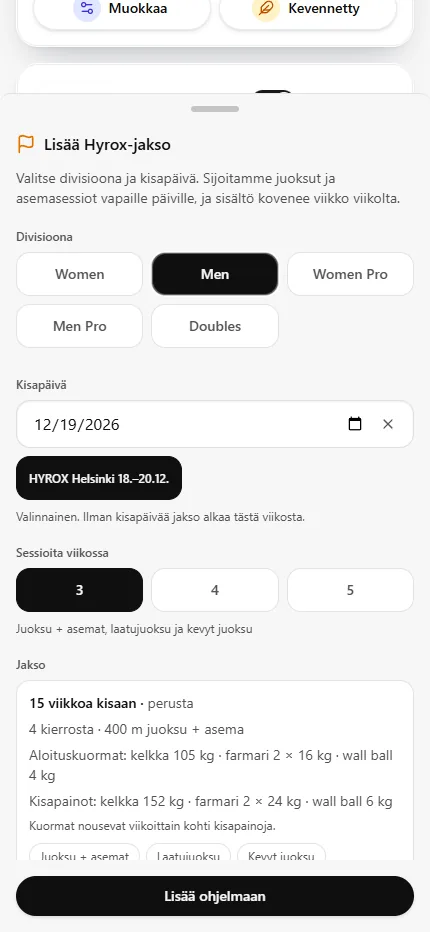
The weekly content changes automatically: the run between stations grows from 400 m to a kilometre, loads climb from 70 percent towards your division’s race weights, deload weeks 4 and 8 also lighten your strength days, and week 9 is a full simulation. The live workout shows the round number and logs metres and load per station. The block is a Premium feature and is included in the free trial.
This is a general training template, not an individually coached programme.
Track the training load
Record duration and perceived effort after each session. Compare similar sessions, not just race weights. Sled surface can greatly change how the same load feels.
If session RPE repeatedly exceeds the table, shorten station distances or reduce loads. Deload weeks 4 and 8 are part of the plan even when training is going well.
The race-load table describes competition rules. It does not prescribe a beginner’s training loads. Practise with your division’s equipment and standards when technique and recovery allow.
Sources
- HYROX Singles Rulebook 26/27: race distances, loads and movement rules. Checked 10 September 2026.
- Brandt et al. (2025): a small observational HYROX simulation study (11 participants); not validation of this training programme.
Free workout program by SisuLift. https://www.sisulift.app/en/workout-programs/hyrox-training-program