


Who the runner's gym program is for
This program is for runners who run 2-5 times a week and want the gym to support running, not become a second sport. Strength training improves running economy, the oxygen cost of each kilometre, and heavy strength work does it more effectively than light circuits (Blagrove et al. 2018). The program suits someone preparing for a first half marathon as well as an experienced marathoner.
Two gym sessions is deliberately few. The runner's gym is not a place to get tired but a place to lift heavy, recover and keep running. Sessions are short, about 45 minutes, with only 5-6 exercises.
Who this is not for
- If the goal is building muscle mass: a 3-day or 4-day program with more sets is the right choice then.
- In race week: drop to two sets or skip the second gym session; week 8 of the program shows how.
- During an acute overuse injury: find the cause first, strength training does not fix mileage that was increased too fast.
Strength workouts A and B
Two short sessions a week, 5-6 exercises each. Main lifts heavy with few reps, because a runner wants strength and stiffness, not fatigue. Rest 2-3 minutes on the main lifts, 90 seconds on the rest.
Strength A
| Exercise | Sets | Reps | Rest | RPE |
|---|---|---|---|---|
| Barbell back squatBeginner: dumbbell goblet squat. | 4 | 4-6 | 3 min | 8 |
| Romanian deadlift | 3 | 6-8 | 2-3 min | 8 |
| Dumbbell Bulgarian split squat | 3 | 6-8 / leg | 90 s | 8 |
| Standing calf raiseHeavy and slow: 2 s up, 3 s down. | 3 | 8-12 | 90 s | 8 |
| Plank | 3 | 30-45 s | 60 s | 8 |
Strength B
| Exercise | Sets | Reps | Rest | RPE |
|---|---|---|---|---|
| Barbell deadliftA trap bar works just as well. | 3 | 4-6 | 3 min | 8 |
| Dumbbell step-up | 3 | 8 / leg | 90 s | 8 |
| Nordic hamstring curlEasier: band assistance or the lowering phase only. | 3 | 4-6 | 2 min | 8 |
| Dumbbell one-arm row | 3 | 8-10 / side | 90 s | 8 |
| Jump squatFrom week 5 onwards only. Soft landing, full recovery. | 3 | 5 | 2 min | 7 |
| Side plank | 3 | 20-40 s / side | 45 s | 8 |
Exercise techniques and animations are in the exercise library: browse all exercises · RPE 7 = about 3 reps in reserve, RPE 8 = 2, RPE 9 = 1.
Weekly calendar around your runs
Gym after an easy run day or on the same day after an easy run, never the day before a long run or hard intervals. Example of a four-run week; on a two-run week the gym sessions stay in the same slots.
- MonEasy run 30-45 min
- TueStrength A
- WedIntervals or tempo run
- ThuRest or an easy run
- FriStrength B
- SatRest
- SunLong run
Progression over weeks 1-8
A runner's progression is in load, not sets. Set counts stay low through the block, and weight is added once the top of the range is filled. Jumps come in only once the main lifts are familiar.
| Weeks | Sets | Load | Note |
|---|---|---|---|
| Weeks 1-2 | 3 sets per exercise | RPE 6-7, top of the range | Technique on the squat and deadlift. Expect soreness; lower running intensity these weeks. |
| Weeks 3-4 | 3-4 sets on the main lifts | RPE 7-8 | Reps down to 4-6 and load up. Full range of motion on the Nordic curl. |
| Weeks 5-7 | 4 sets on the main lifts, 3 on the rest | RPE 8, +2.5-5 kg once the range is filled | Jump squats added to Strength B. Keep gym sessions to 45 minutes. |
| Week 8 | 2 sets per exercise (deload) | About 20 % lighter | Recovery or race week. Then a new block from your week 7 weights; in race season keep the week 8 model on race weeks. |
How the program works
Running economy improves when leg stiffness and force production rise: every stride costs less. Heavy compound lifts with few reps do that without meaningful muscle gain, so there is no extra weight to carry (Blagrove et al. 2018; Balsalobre-Fernández et al. 2016).
Calves, hamstrings and the hip area are a runner's most common injury sites. That is why the program has a heavy calf raise, a Romanian deadlift and a Nordic curl every week. Single-leg exercises (Bulgarian split squat, step-up) load the leg the same way a running stride does.
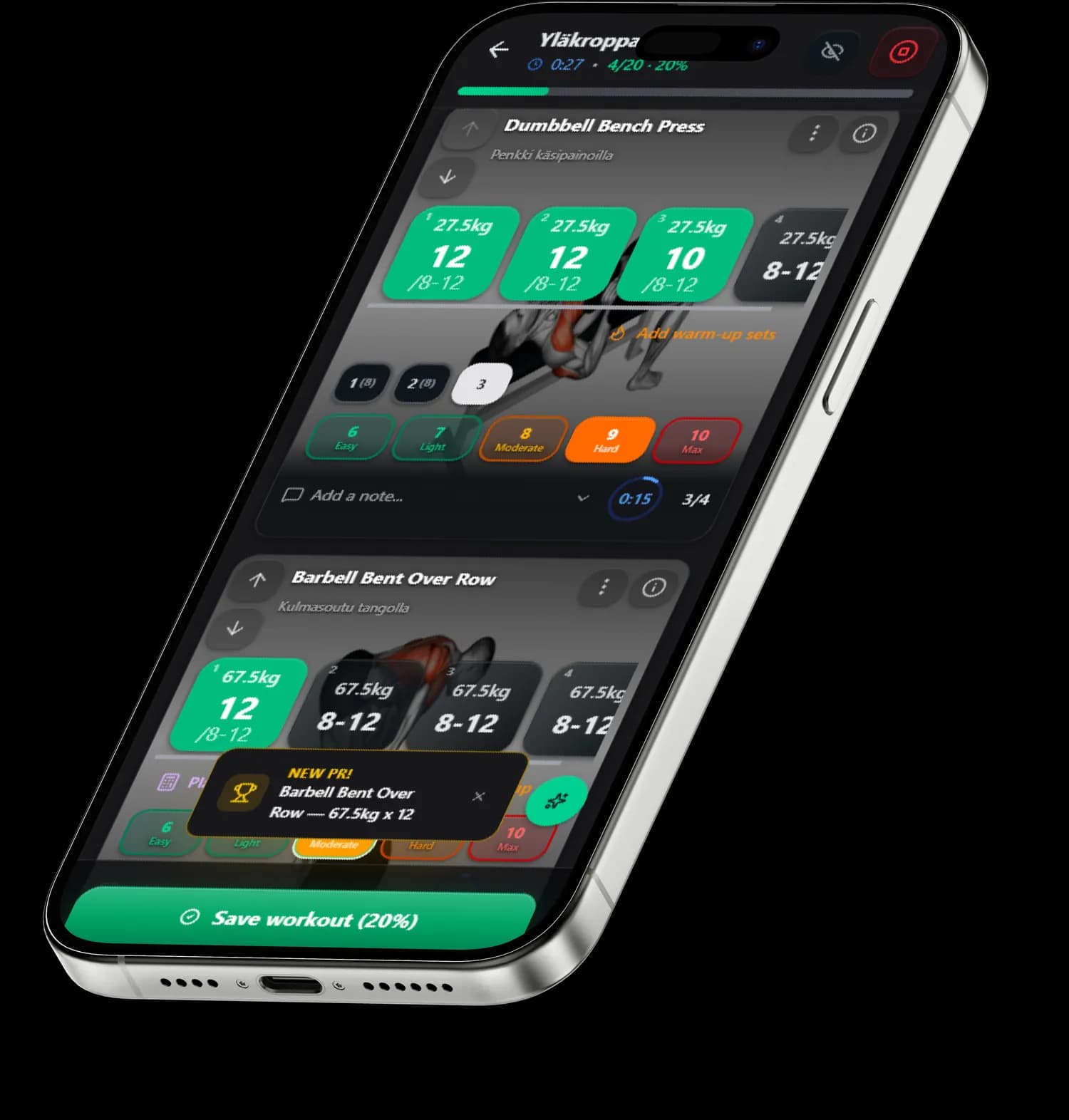
Timing decides: gym after an easy run on the same day or on its own day, never the day before a long run or hard intervals. In race week drop to two sets following the week 8 model. In SisuLift runs and strength days are logged in the same week, and the hybrid running program fits them together automatically.
Sources
- Blagrove, Howatson & Hayes 2018, Sports Medicine: strength training improves running economy and time-trial performance in distance runners; heavy and plyometric training were most effective.
- Balsalobre-Fernández, Santos-Concejero & Grivas 2016, Journal of Strength and Conditioning Research: meta-analysis of strength training, running economy improved in highly trained middle- and long-distance runners.
- Helms et al. 2016, Strength and Conditioning Journal: a reps-in-reserve based RPE scale for regulating load in resistance training.
Free workout program by SisuLift. https://www.sisulift.app/en/workout-programs/gym-program-for-runners