



If you also want to know how much to eat, the calorie calculator works out your calorie needs and macros for your goal.
How Hyrox pacing is calculated
Own-times mode sums running, all eight stations and Roxzone. Running time is eight times kilometre pace. Use full race-distance station times and avoid counting transitions twice.
Target-time and 5 km modes are illustrative assumption models: 50% running, 42% stations and 8% transitions. In 5 km mode, kilometre pace is multiplied by 1.2. No individual prediction accuracy is claimed.
The stations and their shares
Stations appear in race order. Season 26/27 Singles divisions perform 100 wall balls. Model station shares are calculation weights; own-times mode does not use them.
Loads depend on division. Sled surface, valid repetitions and venue transitions affect the total. The station table and its official rulebook source are linked alongside the worked examples.
How to use the target splits
Try the calculated pace in a controlled combination session. Revise the plan if it cannot be maintained after stations. The calculator does not assess technique or recovery.
Record times, loads, recoveries and surface. Update the calculator with measured data. Doubling a half-simulation time is not reliable, and gym-substitution times are not equivalent to race-equipment splits.
Frequently asked questions
What is a good first HYROX time?
There is no universal threshold. Build a target from your running pace, full-distance station times and transitions. This page’s examples are not race-result averages.
How is HYROX running pace calculated?
With own times: eight times the kilometre pace. Target mode assigns 50% of total time to running. The 5 km mode assumes a 20% slower pace; both are rough assumptions.
Can I enter every station split?
Yes. Select Own times and enter running pace, eight full-distance station splits and Roxzone. The calculator sums them without assumed shares.
Can I double a half-simulation time?
Not reliably. Fatigue, transitions and the absence of planned recovery change a full race. Use the simulation to assess technique and pacing.
Where can I find a HYROX training plan?
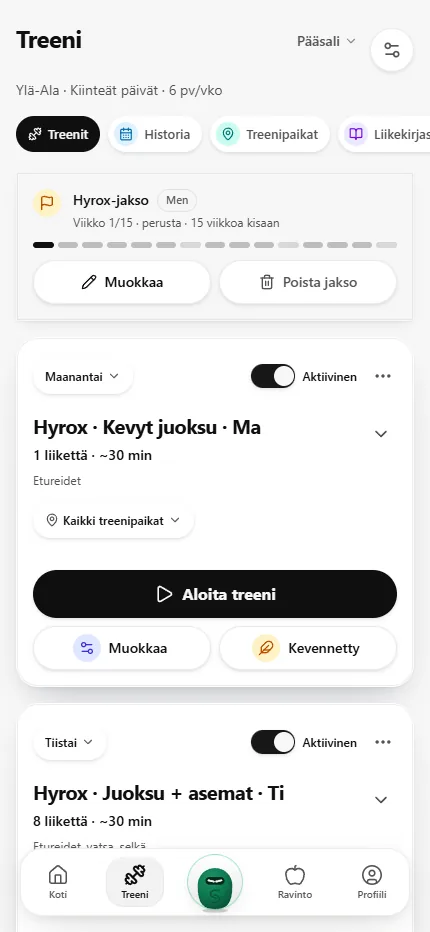
The free 12-week template is on SisuLift’s programme page: two strength sessions, an easy run and a combination each week. The same structure is also available directly in the app as a Hyrox block, placed next to your gym programme and updated weekly towards race weights.
See also
- 01VO2max CalculatorAerobic capacity from the Cooper test, a 2.4 km run or resting heart rate.
- 02Heart Rate Zone CalculatorMax heart rate and five zones, Karvonen formula with resting HR.
- 03Calorie Burn CalculatorHow much does the gym, a run or skiing burn? About 30 activities with MET values.
- 04Working Weight Calculator1RM or your last set turned into set weights by reps and RIR target.