




Updated 11 September 2026. Race facts: Singles and Doubles 26/27.
HYROX combines 8 × 1 km running with eight functional stations. Beginners should check their division’s loads, learn movement standards and practise running between stations. This guide gives you a starting point for your first race. The full 12-week Hyrox training plan week by week and the Hyrox stations with race weights have their own pages.
What is Hyrox?
In a HYROX singles race, run a kilometre and then complete a station. Repeat eight times. The stations are SkiErg, sled push, sled pull, burpee broad jumps, rowing, farmer’s carry, sandbag lunges and wall balls. Roxzone transitions count towards the total time.
Singles Open and Pro differ in loads. Doubles is a pairs event and Relay a team event; each has its own rulebook. This guide’s load table covers Singles. Choose a division based on your skills and ability to handle its loads.
The fixed order helps structure training. Race times are not perfectly comparable across venues: sled friction and transition distances can vary.
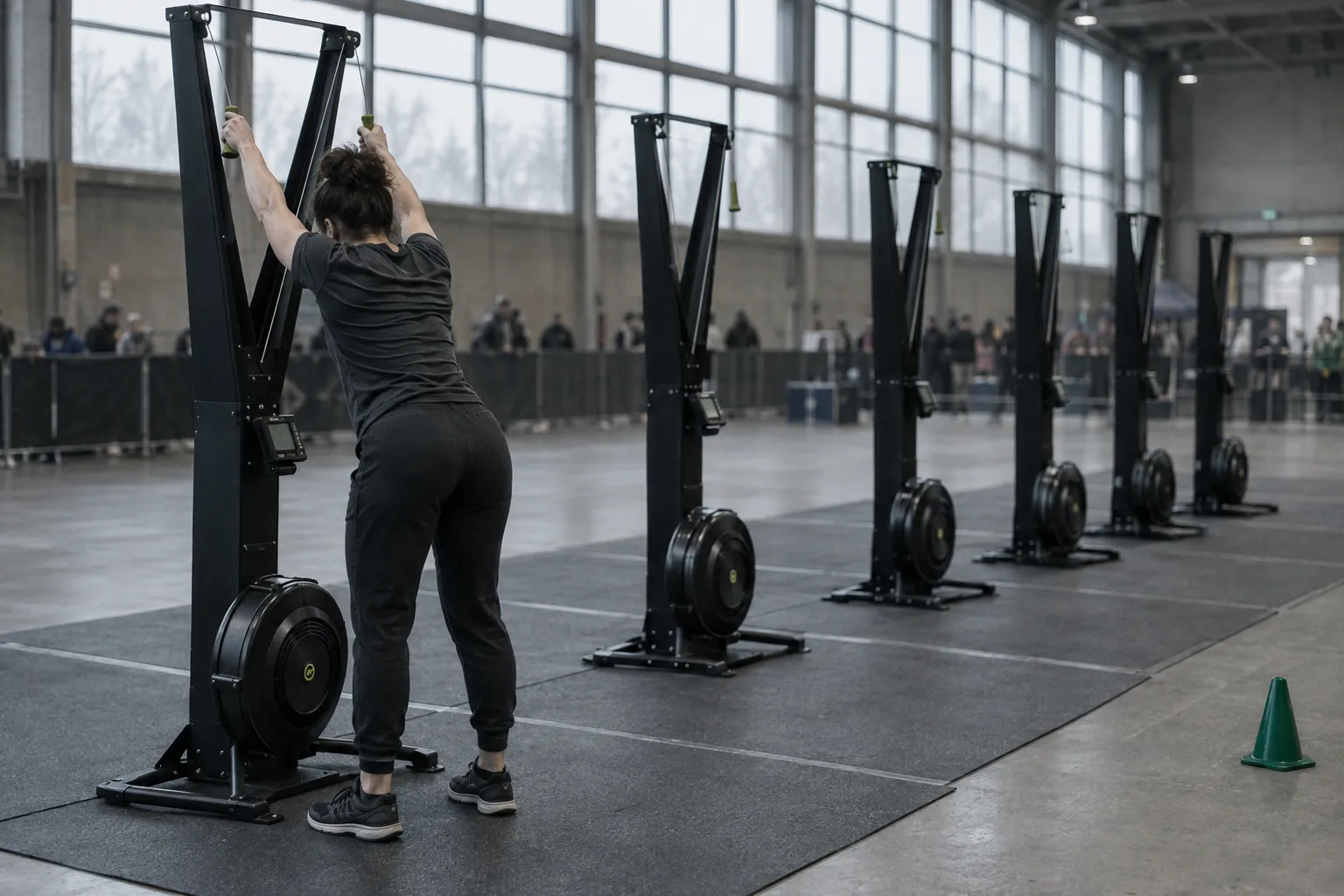
Choose your division before entering
| Format | What it means |
|---|---|
| Singles Open | Individual race with Open loads; train all runs and stations yourself. |
| Singles Pro | Individual race with heavier loads; check every station requirement. |
| Doubles | Pairs race: run together and share station work under the rules. Practise handovers with your partner. |
| Relay | Team relay; check work allocation in its separate rulebook. |
How do I set a target for my first HYROX race?
Start with a performance in which you can maintain technique and controlled effort to the finish. A generic first-timer time threshold does not describe your readiness. Build a target from your running pace, station splits and transitions.
Fictional worked example: 8 km at 6:00 min/km takes 48 minutes. Allocate 41 minutes to eight stations and 7 minutes to Roxzone, giving 1 h 36 min total. This is not a customer result or a race prediction. The same numbers and station breakdown appear in the target-time guide and calculator example.
Try the planned effort in a combination session. Keep the opening runs controlled and plan station sets and breaks. Revise the target using your actual training.
HYROX target times: worked examples and your own plan
Assess your starting point: where should you begin?
These checks help select an initial training load. They are not official entry requirements, fitness tests or a guarantee of finishing. Learn movements while fresh first.
Assessing your training starting point
| Area | What to check | How to use it |
|---|---|---|
| Easy running | Can you move conversationally for 30 min, using run–walk if needed? | Build a base before the 12-week plan if this is a new load. |
| Squats and lunges | Are movements controlled with light loads? | Learn technique and choose repetitions in reserve before adding weight. |
| Sled and rope | Have you used the real equipment? | Arrange technique practice; gym strength does not show how sled friction feels. |
| Carries and wall balls | Can you perform short, controlled sets? | Plan breaks and sets; long unbroken sets are not a starting requirement. |
| Recovery | Do you recover before subsequent sessions? | Fit four sessions into your current overall load. |
Running experience does not replace station practice, and gym strength does not replace adapting to running. If basic movements or running are new, start with an easier phase and allow preparation time according to your progress.

A 12-week path to your first race
The 12-week template has four sessions per week: two strength workouts, an easy run and a run–station combination. Running appears in two sessions. The example below is generated from the same programme data as the full plan.
| Day | Session | Prescription | Duration |
|---|---|---|---|
| Mon | Strength A | 3 sets/exercise, RIR 3 | 45–60 min |
| Tue | Easy run | Conversational effort, RPE 3–4/10 | 45 min |
| Wed | Rest | – | – |
| Thu | Strength B | 3 sets/exercise, RIR 3 | 45–60 min |
| Fri | Rest | – | – |
| Sat | Run + stations | 600 m run + SkiErg 500 m → 600 m run + Sled push 25 m → 600 m run + Burpee broad jumps 40 m → 600 m run + Rowing 500 m. One pass; total running 2.4 km. Rest after each station 90 s. RPE 6–7/10. | 45–65 min |
| Sun | Rest or optional easy walk | No fifth demanding session | 0–30 min |
Weeks 1–3 establish rhythm and technique. Weeks 4 and 8 reduce load. Weeks 5–7 build training, week 9 includes a half-distance simulation and week 10 uses kilometre runs between stations. Week 11 tapers; week 12 has three short activations and the race.
→ Hyrox training programme, 12 weeks: the full programme week by week
The full plan includes every week’s volumes, substitutions and load adjustments. If you want the same structure on your phone, SisuLift builds it for you: the Hyrox block places runs and station sessions on your free days next to your current gym programme and updates the content week by week. More on that in the next section.
First station session: week 1’s A combination is one pass through 400 m run + 500 m SkiErg, 400 m run + 25 m push, 400 m run + 40 m burpee broad jumps and 400 m run + 500 m row. Rest 120 s between blocks, use light loads and RPE 5–6/10. Total running is 1.6 km. Warm-up and adaptations are on the programme page.
The programme's key exercises in the exercise library with animations: Barbell back squat, Romanian deadlift, Dumbbell walking lunge, Farmers walk, Burpee, SkiErg.
The Hyrox block in SisuLift: programme, stations and watch
The 12-week structure from this guide now lives inside the app. Under Workouts, the Add menu has Add Hyrox block, which builds race preparation alongside your existing gym programme. Your strength days stay, Hyrox sessions go on free days, and the station session never lands the day after a leg day.
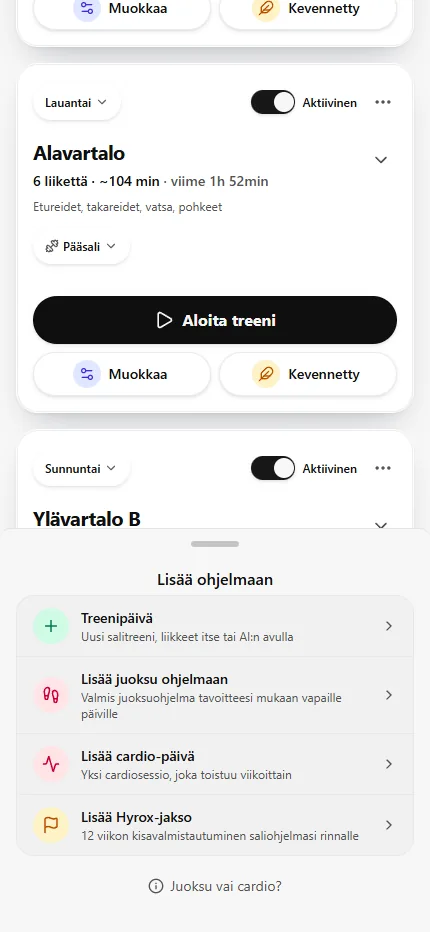
You choose three things: the division (Women, Men, Women Pro, Men Pro or Doubles), the race date and the number of sessions. HYROX Helsinki 18–20 December is a one-tap preset. The app handles the rest:
- Three sessions per week: run + station rounds, a quality run and an easy run. Four adds a long run and five adds a second station session.
- The content gets harder week by week: the run between stations grows from 400 m to a full kilometre, and station loads climb from 70 percent towards your division’s race weights.
- Deload weeks 4 and 8 also lighten your strength days automatically. Week 9 is a full simulation and race week is just a short touch on the stations.
- With more than 12 weeks to race, the base phase is extended. With fewer, the block starts straight from the build phase. You can edit or remove the block at any time.
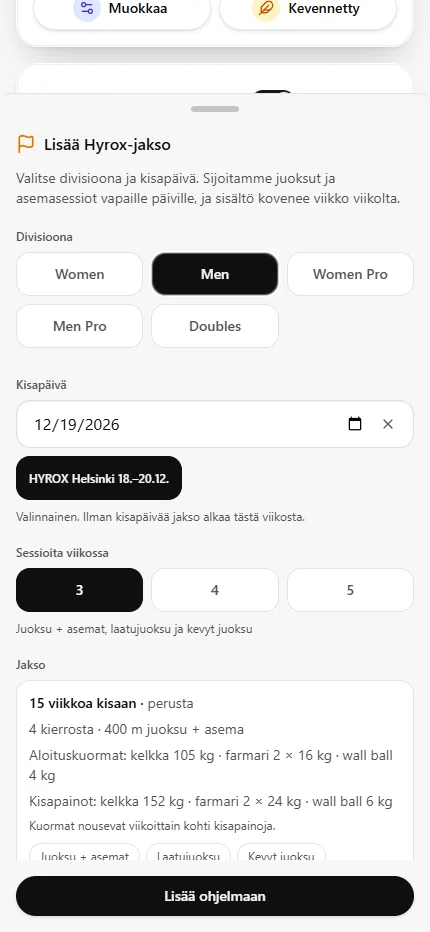
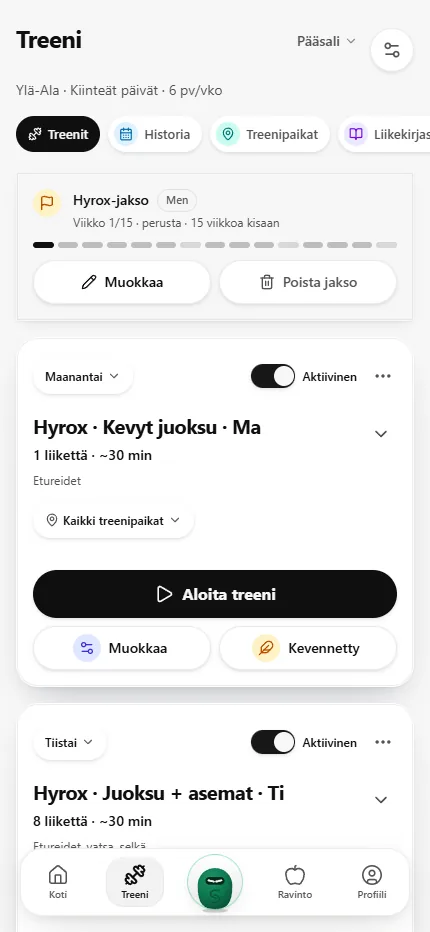
The preview shows starting loads and race loads side by side, so a 105 kg sled in week one does not look like a mistake. It is 70 percent of the Men division’s 152 kg. In the programme view the block card shows the week, the phase and the weeks to race, and every Hyrox day is its own workout card among the others.
Station sessions as rounds, not sets
The station session is built like the race: a run followed immediately by a station, four rounds. The live workout shows the round number, and each station logs metres or reps plus the load. Sled push 25 m at 105 kg, SkiErg 500 m, burpee broad jumps 40 m and rowing 500 m make up session A. Session B has the sled pull, farmers carry, sandbag lunges and wall balls.
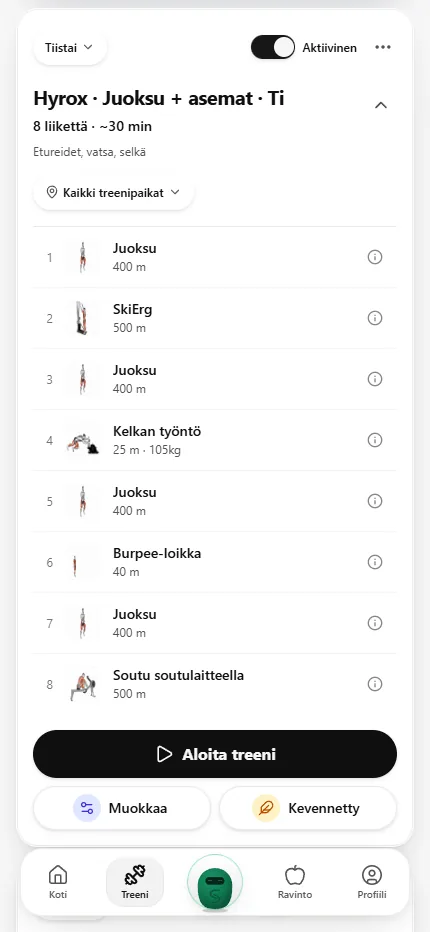
Loads are always derived from your division’s race load and rounded to real equipment sizes, for example farmers carry 2 × 16 kg in the base phase and 2 × 24 kg in the race-specific phase. All eight stations are in the exercise library with animations, and the wall ball instructions follow the race standard: squat below parallel and hit your own target.
Watch, group class and coach
Hyrox is its own sport in the app. A Hyrox session or race recorded on your watch arrives in history through Apple Health or Health Connect, and in the latest app version a session named Hyrox is recognised as the sport automatically. Profile has a guide under Watch & health data, Your watch and Hyrox, covering Polar, Garmin, Apple Watch and Samsung. Training load counts towards recovery with a Hyrox profile, not a circuit-training one.
If you attend a Hyrox class at your gym, add it to the programme as a class day and mark it done with one tap afterwards. The coach knows your block’s phase and week, so you can ask it how to use a deload week or what the next station session looks like.
Two limits, honestly: the Hyrox block is a Premium feature and is included in the free trial. Station splits from a race are logged manually for now, because for example Polar does not export lap times to Apple Health.
The eight stations in brief
These are the season 26/27 Singles stations and loads. Run a kilometre before each station. Read the station guide and official rulebook for movement standards.
| Station | Distance / reps | Women Open | Men Open | Women Pro | Men Pro |
|---|---|---|---|---|---|
| 1. SkiErg | 1000 m | – | – | – | – |
| 2. Sled push | 50 m | 102 kg | 152 kg | 152 kg | 202 kg |
| 3. Sled pull | 50 m | 78 kg | 103 kg | 103 kg | 153 kg |
| 4. Burpee broad jumps | 80 m | – | – | – | – |
| 5. Rowing | 1000 m | – | – | – | – |
| 6. Farmers carry | 200 m | 2 × 16 kg | 2 × 24 kg | 2 × 24 kg | 2 × 32 kg |
| 7. Sandbag lunges | 100 m | 10 kg | 20 kg | 20 kg | 30 kg |
| 8. Wall balls | 100 reps | 4 kg | 6 kg | 6 kg | 9 kg |
Run 1 km before every station. Sled weights include the sled. Wall ball target height: women 2.70 m, men 3.00 m. This table covers Singles; check the separate rules for Doubles, Relay and Adaptive.
Source: HYROX Singles rulebook 26/27, pages 8 and 35. Checked 7 September 2026.
All listed Singles divisions perform 100 wall balls. Race loads are not beginner training prescriptions: start with weights that allow clean repetitions and practise division loads gradually.

→ Hyrox stations: all 8 stations, technique and training tips
Race day: gear, nutrition and pacing
- Before starting: check your start time, collect timing equipment and read the athlete instructions.
- Use a familiar warm-up and enter the start zone on the organiser’s schedule.
- During the race: track running laps and station order. Roxzone is the transition area between running and stations.
- After finishing: return timing equipment as instructed and review your splits later.
Gear
- Shoes tested for both running and sled pushing.
- Socks and clothing that do not chafe, plus a change for afterwards.
- A familiar watch if you use one in training.
- Check the athlete guide for permitted equipment, drinks stations and your start time.
Nutrition
Use familiar food and hydration routines from training. Test meal timing and any during-race drink beforehand. Read the organiser’s instructions on nutrition and drinks stations.
Pacing

Start at a controlled effort you have already tried in run–station sessions. Follow perceived effort, not just fresh running pace. If early stations push effort too high, slow down early.
Plan wall ball sets and carry breaks in advance. The HYROX calculator’s own-times mode accepts running pace, all eight station times and Roxzone separately. Default models are illustrative calculations, not personal predictions.
→ Hyrox calculator: estimate your race time and kilometre pace
The most common mistakes
- Starting faster than the effort you have practised.
- Learning movement standards only while fatigued: begin with fresh technique practice.
- Only lifting or only running; practise their combination too.
- New equipment or untested food on race day.
- Wall balls without a set plan or valid-repetition practice.
- Replacing deload weeks with extra hard sessions.
Hyrox races in Finland
HYROX Helsinki is scheduled for 18–20 December 2026. Check your division, start day and entry availability on the organiser’s event page. HYROX Helsinki
With the race at the end of week 12, a plan targeting December begins around late September. The exact start depends on your race day. Rushing the table does not replace a missing fitness base.
Sources
- HYROX Singles Rulebook 26/27: distances, loads and movement standards (checked 10 September 2026).
- HYROX Doubles Rulebook 26/27: doubles divisions and loads (checked 10 September 2026).
- HYROX Helsinki: event 18–20 December 2026
→ Read also: HIIT workout, 5 ready-made sessions | Beginner gym programme, 8 weeks