




A hybrid athlete trains strength and endurance at the same time and wants to be good at both: lift heavy and run long. The short answer to the most common fear: a sensible amount of endurance work does not eat your muscle or your max strength when the week is built well. This guide pulls together what research says about combining strength and endurance, how to build the week around your goal, how to plan the year in blocks, what to eat and how to know you are improving at both.
What is a hybrid athlete?
A hybrid athlete deliberately trains two opposite qualities: max strength and muscle in the gym, and aerobic endurance by running, cycling, rowing or skiing. The goal is not to be world class at either, but clearly above average at both. The same person squats one and a half times their bodyweight and runs a half marathon.
In practice there are three types of hybrid athletes:
- The lifter who runs. The gym leads, and running adds fitness, health and work capacity. Typically 3-4 gym sessions and 2-3 runs a week.
- The runner who lifts. Mileage leads, and the gym makes running more economical and more durable. 2-3 gym sessions in base season, 1-2 in race season.
- The competitor who needs both. HYROX, obstacle races and military or firefighter fitness tests demand strength and endurance in the same effort.
Hybrid training is also the name of many group fitness classes. A class can be a good workout, but in this guide hybrid training means programming the whole week and year, not a single class.
When can you call yourself a hybrid athlete?
There is no official line. Below is our rough level table to help you see which side needs more work. If you are advanced in one and a beginner in the other, you know where to put the next training block.
Rough hybrid levels (one rep max relative to bodyweight and run time)
| Level | Squat | Deadlift | 5 km | 10 km |
|---|---|---|---|---|
| Beginner | 1 × bodyweight | 1.25 × bodyweight | under 30 min | under 1 h |
| Intermediate | 1.5 × bodyweight | 1.75 × bodyweight | under 25 min | under 52 min |
| Advanced | 2 × bodyweight | 2.5 × bodyweight | under 20 min | under 42 min |
For women, strength thresholds are typically about a fifth lower and run times about ten percent slower. You do not need to test a true one rep max, you can estimate it from a heavy set (see metrics below).
The hybrid athlete physique
A hybrid athlete is usually not as big as a bodybuilder or as light as a marathoner. The typical result is athletic: a fair amount of muscle, a fairly low body fat and fitness that carries you through daily life and races. Looks still depend most on genetics, eating and which side you emphasise.
Where hybrid training came from and why it is growing now
Combining strength and endurance is not a new idea. In 1980 Robert Hickson published a study where subjects lifted five days and did endurance work six days a week. Strength improved for seven weeks just like with lifting alone, then plateaued and dropped in weeks 9 and 10. That is where the term interference effect comes from, and gym culture kept the belief that running kills gains for decades.
Hickson's subjects trained more than ten times a week, which is more than almost any recreational athlete does. Coach Alex Viada later wrote The Hybrid Athlete on how to develop both with sensible programming, and Nick Bare made the term popular by naming his program hybrid in 2018.
The real growth came with HYROX. The first race was held in Hamburg in 2017 with about 650 participants, and according to the organiser there were more than 650,000 racers in the 2024/25 season. Finland's first HYROX was held in Helsinki in May 2026. When a race has eight kilometres of running with sled pushes and wall balls in between, gym only or running only is no longer enough.
For health the combination makes sense anyway. Physical activity guidelines, including the Finnish UKK Institute's, recommend both endurance exercise and muscle strengthening every week, and a hybrid athlete does both with a goal.
Hybrid training in SisuLift data
We looked at the last 30 days of October 2026 in SisuLift's anonymised data. Of 666 users who lifted, 199 or 30 percent also did a separate endurance session in the same period, not counting walking, yoga or ball games. Cycling and running were the most common sports, and about 90 percent of endurance sessions came straight from a watch.
The most interesting finding: people who also trained endurance went to the gym more often than people who only lifted, on average 1.9 times a week vs 1.5. Endurance did not take gym sessions away, it came on top. There were 79 weekly hybrids with at least four gym and four endurance sessions in the month, and their average week had 2.5 gym sessions and 3 endurance sessions.
The interference effect: smaller than gym lore says
The interference effect means endurance training can slow down strength training results, because the two send partly opposite signals to the muscle. In the meta-analysis by Wilson et al. (2012), concurrent training built somewhat less muscle and strength than lifting alone, and the effect was linked to running in particular and to the frequency and duration of endurance sessions.
The newer picture is much calmer. In the updated meta-analysis by Schumann et al. (2022), based on 43 studies, concurrent training did not reduce muscle growth or max strength. A clear cost showed up only in explosive strength, mostly when both were done in the same session. Murach and Bagley (2016) reached a similar conclusion: the evidence for interference with muscle growth is weaker than often claimed.
Three situations where interference is still worth taking seriously:
- You are already well trained. In the meta-analysis by Petré et al. (2021), lower body max strength suffered from concurrent training in trained people, but not in untrained or moderately trained ones.
- You are a man and your goal is leg strength. In Huiberts et al. (2024), with 59 studies, a small cost to lower body strength appeared in men but not in women.
- You need power. Jump and sprint ability are the most sensitive, so in power sports keep hard endurance sessions away from lifting.
Same day order, hours between sessions and running after leg day are covered in more detail in our guide to combining running and strength training in the same week. This guide focuses on the big picture.
How to train like a hybrid athlete: 6 principles
Once interference is not a blocker, the structure of the week decides. These six principles show up in almost every hybrid program that works:
- Pick a priority per block. You can develop both at once, but one is always more important. Write the block goal down, for example +10 kg on the squat or 10 km under 50 minutes.
- Keep hard days hard and easy days easy. A heavy leg session and intervals do not belong on back to back days. Upper body lifting and a hard run work well on the same day.
- Do most endurance easy. In recreational runners about 80 percent at low intensity and the rest hard produced a better 10 km result than moderate steady running (Muñoz et al. 2014). A newer network meta-analysis (Rosenblat et al. 2025) is a reminder that 80/20 is not dogma, since a pyramidal split also works for recreational athletes. What matters is that not every run is moderately hard.
- Most important first, with long gaps. When strength came before endurance in the same session, lower body strength improved more (Murlasits et al. 2018, Eddens et al. 2018). At least three hours between sessions reduces the cost.
- Add one thing at a time. When mileage goes up, hold gym loads steady for a while and vice versa. Two rising loads at once is the fastest route to a plateau or an overuse injury.
- Deload regularly. A hybrid athlete collects fatigue from two sources, so a deload week every 4-8 weeks keeps both sides fresh. Read more about the deload week.
Hybrid athlete weekly split: 4, 5 and 6 day plans
Below are five ready weekly splits for different goals. They are built so that a heavy leg day and a hard endurance session never land on consecutive days. Move rest days to fit your calendar, as long as that rule holds.
Hybrid athlete weekly splits by goal (gym + endurance)
| Week | Mon | Tue | Wed | Thu | Fri | Sat | Sun |
|---|---|---|---|---|---|---|---|
| Minimum dose (2 + 2) | Full body | Rest | Easy run 40 min | Rest | Full body | Rest | Long run 60 min |
| Balanced (3 + 3) | Lower body | Easy run 45 min | Upper body | Intervals | Rest | Full body | Long run |
| Strength focus (4 + 2) | Lower body heavy | Upper body | Easy run 40 min | Rest | Lower body light | Upper body | Long run |
| Endurance focus (2 + 4) | Full body | Easy run | Intervals | Easy bike 30 min | Full body light | Rest | Long run |
| HYROX block (3 + 3) | Run intervals | Lower body + sled | Easy run | Upper body + rower | Rest | Run and stations alternating | Long easy run |
An easy run means a pace where you can speak in full sentences. Intervals can be for example 5 × 3 min hard with two minute recoveries. The long run is the longest, calm session of the week. You can swap running for cycling, rowing, skiing or the cross trainer when legs or joints need a break.
Hybrid athlete training program for beginners
If you are starting from scratch, start with the minimum dose. Two full body gym sessions and two runs a week is enough to improve both for the first months, because interference barely shows up in beginners. A gym session is built from 5-6 exercises: squat or leg press, deadlift or hip thrust, bench press or push up, a row, an overhead press and core. For running, start with walk and jog intervals if 30 minutes of continuous jogging is not there yet.
When the minimum dose feels easy, add one easy run first and only then a third gym session. You will find ready gym plans in our workout programs.
A year in blocks: strength block, endurance block and race block
You should not push everything equally hard all year. The approach that works is to split the year into 6-12 week blocks where the priority changes and the other side is kept on maintenance. Maintenance takes surprisingly little: 1-2 heavy gym sessions a week keep your strength, as long as the load stays heavy and only the number of sets drops.
A hybrid athlete year in blocks
| Block | Length | Gym | Endurance | When |
|---|---|---|---|---|
| Strength block | 6-10 wk | 3-4×, progression is the priority | 2× easy | Winter, no races |
| Endurance block | 8-12 wk | 2×, load holds, sets drop | 4-5×, mileage rises | Before a running race |
| Balanced block | 6-8 wk | 3× | 3× | Base season, general fitness |
| Race block | 8-12 wk | 2-3×, sport specific | 3-4×, race pace | HYROX, obstacle race |
| Deload | 1 wk | about half the volume | about 60-70 % of volume | Every 4-8 weeks |
As a race gets closer the emphasis shifts towards the sport: from a balanced 50/50 split to 70/30 or 80/20 in favour of endurance for the final weeks. In the last week you back off from both, but keep intensity with short efforts and a few heavy sets.
Strength training for hybrid athletes
A hybrid gym program is simpler than a bodybuilder's. Time and recovery also go to endurance, so every gym session has to do a lot with low volume.
- Compound lifts as the base: squat, deadlift, bench press, pull up, overhead press and rows.
- Heavy sets of 3-6 reps with 1-3 reps in reserve. Heavy load builds strength without the big fatigue that would spill into tomorrow's run.
- Single leg work, such as Bulgarian split squats and lunges, for running stability and to even out side to side differences.
- Jumps and bounds once or twice a week. In highly trained runners, 2-3 strength sessions a week for 8-12 weeks clearly improved running economy (Balsalobre-Fernández et al. 2016).
- Isolation work only if time is left. It is not forbidden, it just comes last.
For a runner the gym is not a necessary evil but a performance tool. A ready plan is in our gym program for runners.
Endurance training: running, bike or rower?
Running is the most common endurance sport for hybrid athletes, because it needs no equipment and sits at the core of many races. It is also the hardest on the legs, because every stride has a braking phase. In Wilson's meta-analysis the cost to strength was linked to running and not cycling, but in the newer data from Schumann and Sabag there was no clear difference between modes.
In practice the bike, rower and skis are good ways to add endurance volume when your legs are heavy from a gym block or your running mileage cannot go up any more. If your goal is a running race, most of your endurance still needs to be running.
Three intensity zones are enough:
- Easy: you can talk in sentences, heart rate around 60-75 % of max. Most of the week's minutes.
- Threshold: you can only say a few words, hard but controlled. Tempo runs and longer reps.
- Hard: you cannot talk. Short intervals, for example 4 × 4 min or 8 × 400 m.
Hybrid athlete diet: energy, protein and carbs
The most common reason a hybrid athlete improves at neither is eating too little. Two training modes burn more than either alone, and an energy deficit hurts both recovery and strength gains.
- Energy: eat at least what you burn if the goal is to improve. Losing weight and raising performance at the same time only works slowly.
- Protein: 1.4-2.0 g per kg of bodyweight per day is enough for most people who train (ISSN 2017). Spread it over 3-5 meals, around 20-40 g each.
- Carbs: about 5-7 g/kg with around an hour of moderate training a day, and 6-10 g/kg with 1-3 hours of endurance work (ACSM 2016). Less on easy days.
- On double days: eat carbs and protein after the first session so the second one does not start on an empty tank.
- Fluids and salt: after long runs and hot gym sessions, drink and salt your food until your urine is pale again.
Work out your protein needs with the protein calculator and your daily energy needs with the calorie calculator.
Recovery: sleep, resting heart rate, HRV and total load
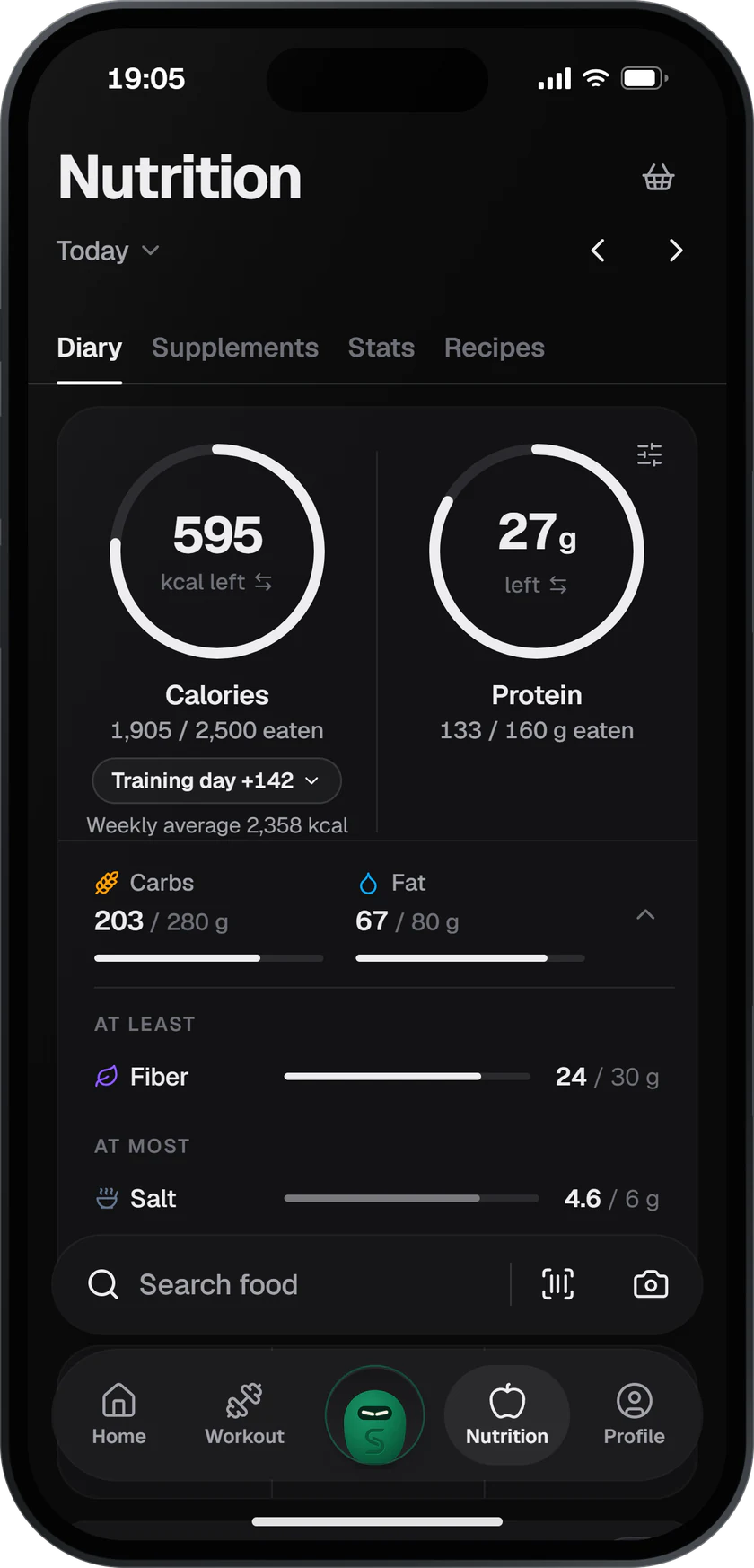
Recovery is more complex for a hybrid athlete than for a pure lifter or runner, because fatigue builds from two sources into the same legs. Four things decide:
- Sleep 7-9 hours. Short sleep shows up first in hard sessions and hurts both sides.
- Resting heart rate and HRV: watch the trend, not a single morning. If resting heart rate is clearly up and HRV down for several days, ease off the next hard session.
- Total load: look at gym volume and endurance minutes in the same picture. A sudden jump in weekly total load is a typical cause of overreaching, so raise it gradually.
- Feel: if your usual working weight feels two reps heavier than last week, that is a signal, not weakness.
Metrics: are you really improving at both?
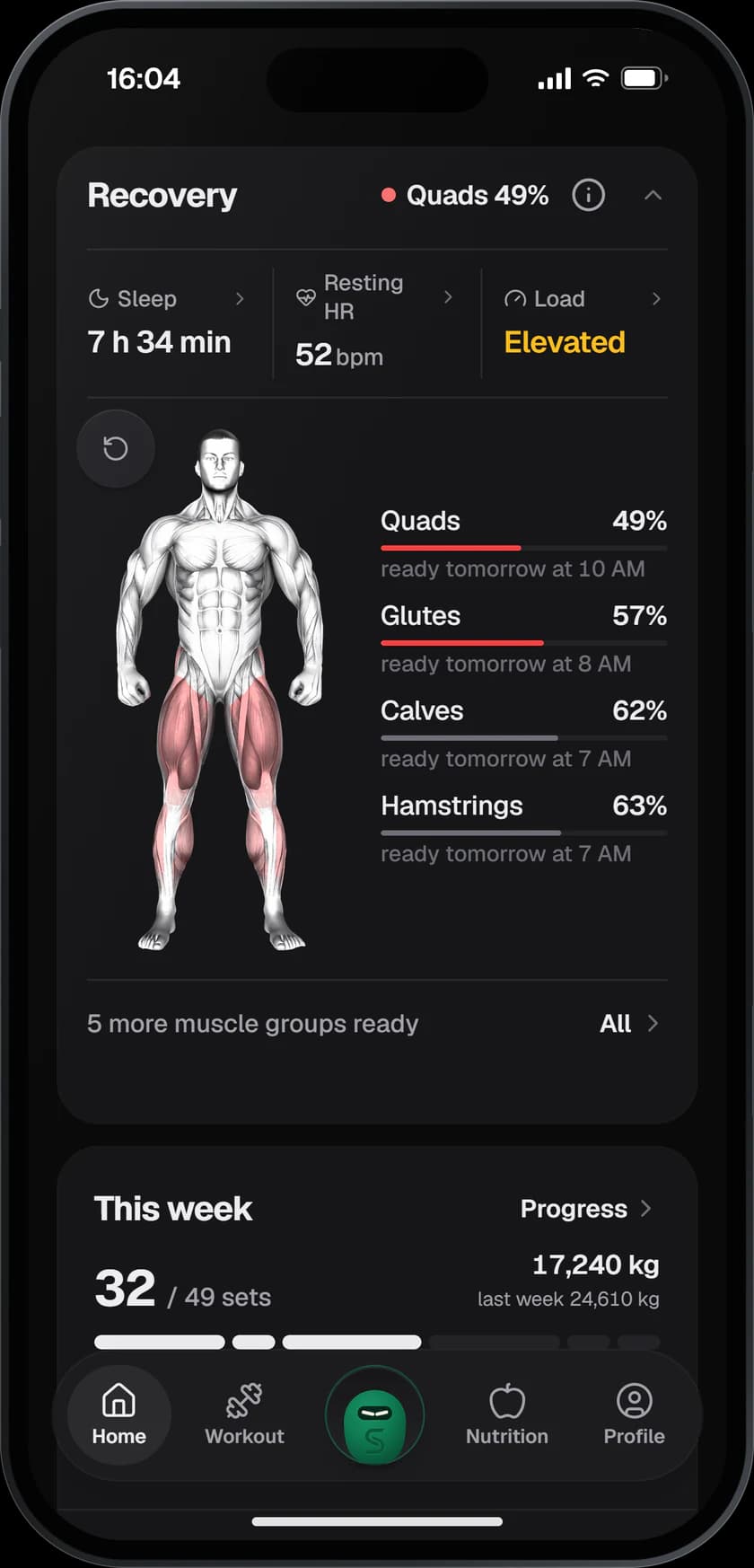
The biggest trap for a hybrid athlete is feeling busy while neither side improves. So pick one or two metrics for each and check them every 6-12 weeks.
- Strength: estimated one rep max for squat, deadlift and bench. For example 100 kg × 5 equals about 117 kg with the Epley formula, so you get an estimate from every heavy set without max testing. Work out yours with the one rep max calculator.
- Endurance: 5 km or 10 km time, the Cooper test or heart rate versus pace on the same easy loop.
- Body composition: waist and bodyweight monthly, if you want to see whether muscle holds as mileage rises.
- Racing: in HYROX, station splits and run lap times tell you which side slows you down.
Hybrid vs HYROX vs CrossFit
Hybrid training is a way of training, HYROX and CrossFit are sports. In HYROX you run 8 × 1 km with one station after each kilometre, such as the sled push, the rower or wall balls. It is a natural race for a hybrid athlete, because a big share of the time is running and the rest is strength endurance. CrossFit leans more on gymnastics, weightlifting and varied short efforts, and needs less long aerobic endurance.
If you want a race that a hybrid week prepares you for directly, HYROX is the obvious choice. Start with our HYROX for beginners guide and the ready 12 week HYROX training program.
The most common hybrid athlete mistakes
- Easy runs too hard. When every run is moderately hard, hard days are not hard and easy days do not recover.
- Two full programs on top of each other. A full gym program and a full marathon plan in the same week exceeds recovery. One is always on maintenance.
- Under eating. Someone training two sports needs more food than either alone.
- A hard run after a heavy leg day. That combination gives you the worst version of both.
- Skipping deloads. Fatigue from two sources does not show in one session but weeks later.
- Two apps, two truths. When lifting lives in one app and running in another, neither knows about the other and total load goes unseen.
What equipment does a hybrid athlete need?
Less than many think. The basics are a gym, or at home a barbell and rack or adjustable dumbbells, good running shoes and a watch or phone that records runs. A chest strap makes easy runs more accurate. Without a gym you can train hybrid with dumbbells, a kettlebell and bands, as long as the load is enough for heavy sets of 5-12 reps.
How SisuLift handles a hybrid week
The biggest practical problem for a hybrid athlete is that lifting and endurance live in different places. In SisuLift they share one program, one history and one recovery view.
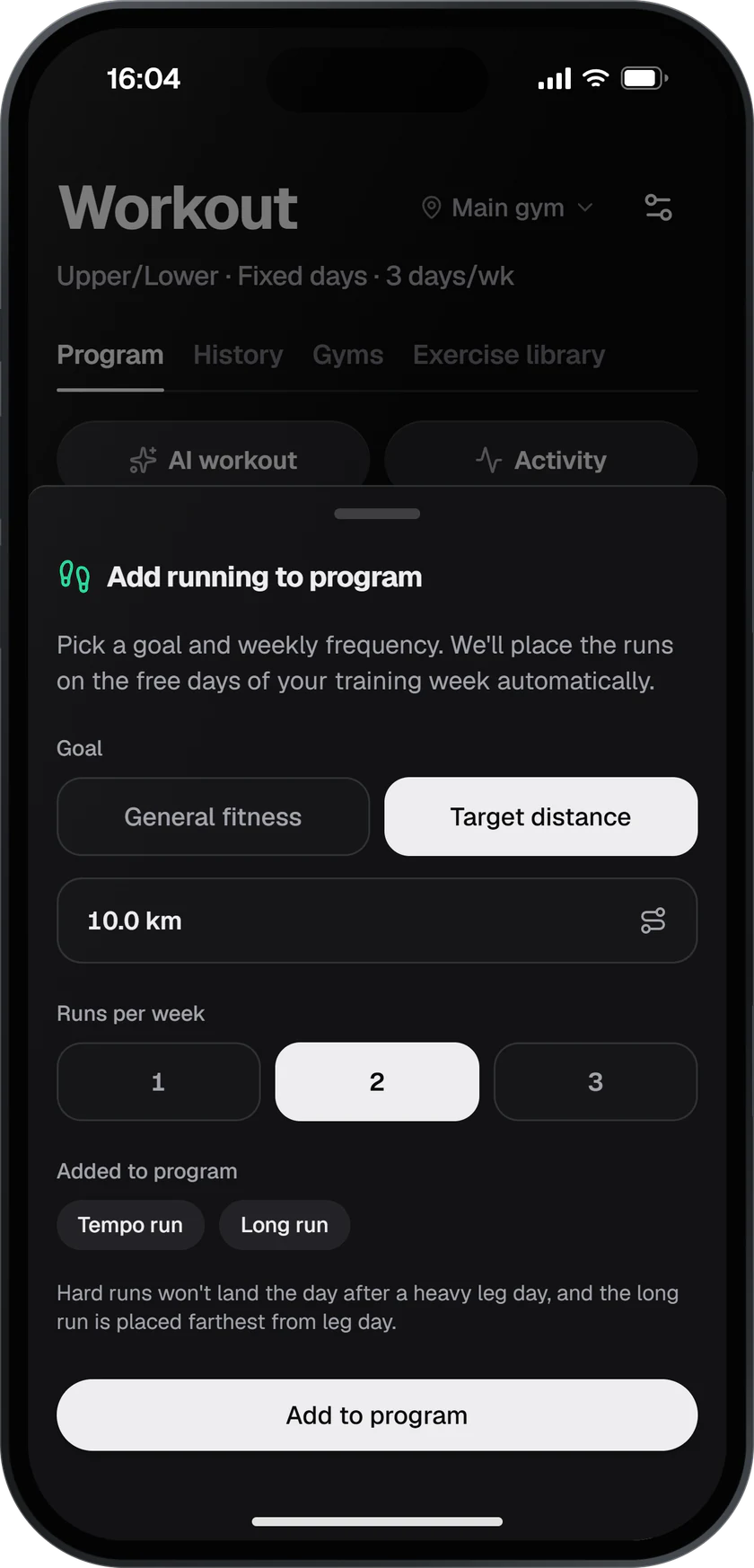
- Runs in your gym program. From the add menu on the Program view of the Workout tab (Add running to program) you pick a goal and 1-3 runs a week. The app places them on free days so hard runs never land the day after a heavy leg day, and the long run goes as far from leg day as possible. From the same menu you can add a cardio day for cycling, rowing or skiing and a 12 week HYROX block.
- Watch workouts in the same history. Polar connects directly. Garmin, Apple Watch, Samsung, Oura and Suunto workouts come into the phone app through Health Connect or Apple Health. Runs and rides show up in the week strip on the home screen with their own sport icons next to gym sessions.
- Recovery from both sources. Running and cycling load the muscle map just like lifting does. The recovery section shows sleep, resting heart rate and total load, which counts gym sets and endurance in one number even without a watch. If you ran in the last 24 hours and today is leg day, the home screen tells you.
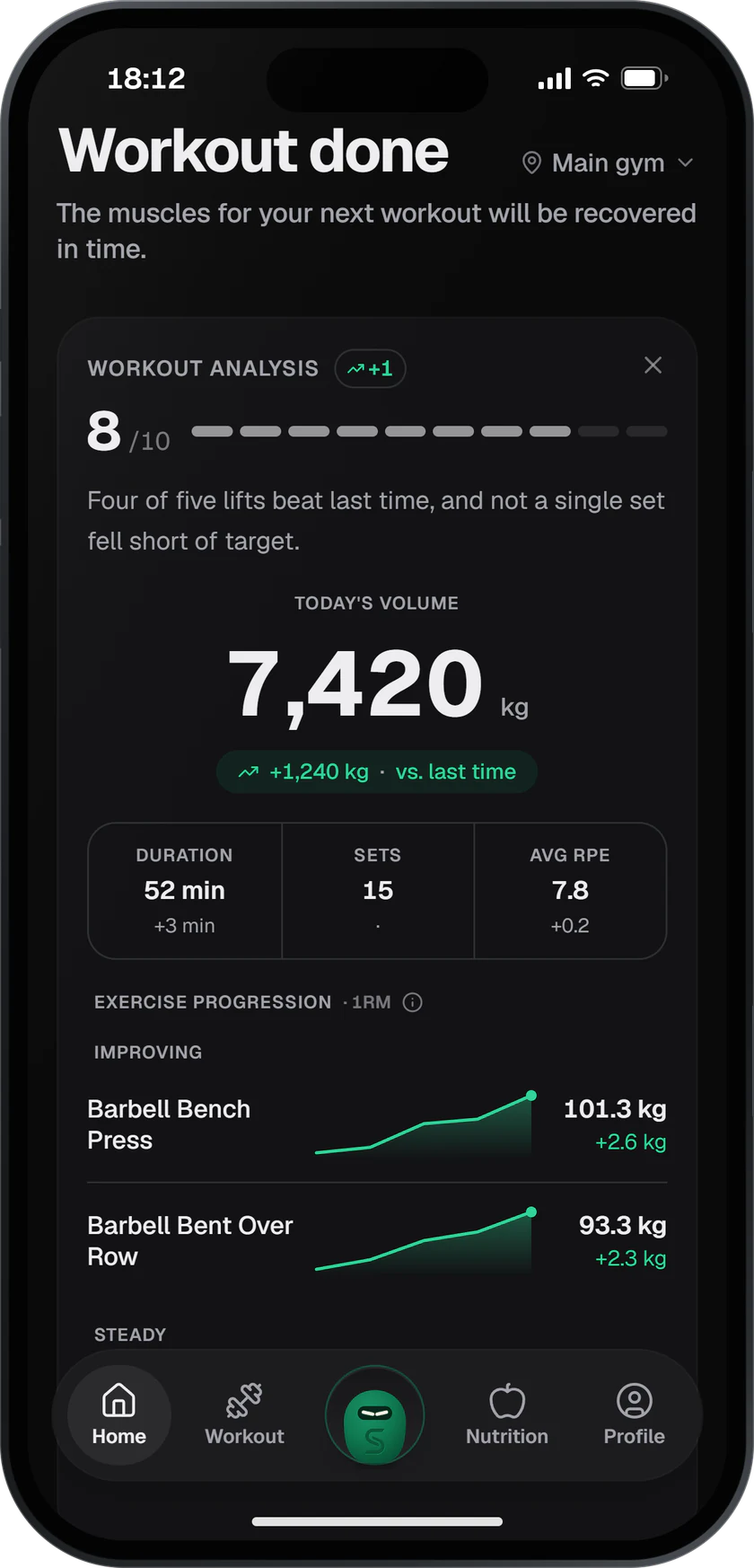
- Nutrition that follows the training day. Calories and macros in the Nutrition tab flex between training and rest days.
- Grind knows both. The Grind coach sees your sports from recent weeks and your leg load, and the weekly analysis puts running distance and endurance time next to your lifting.
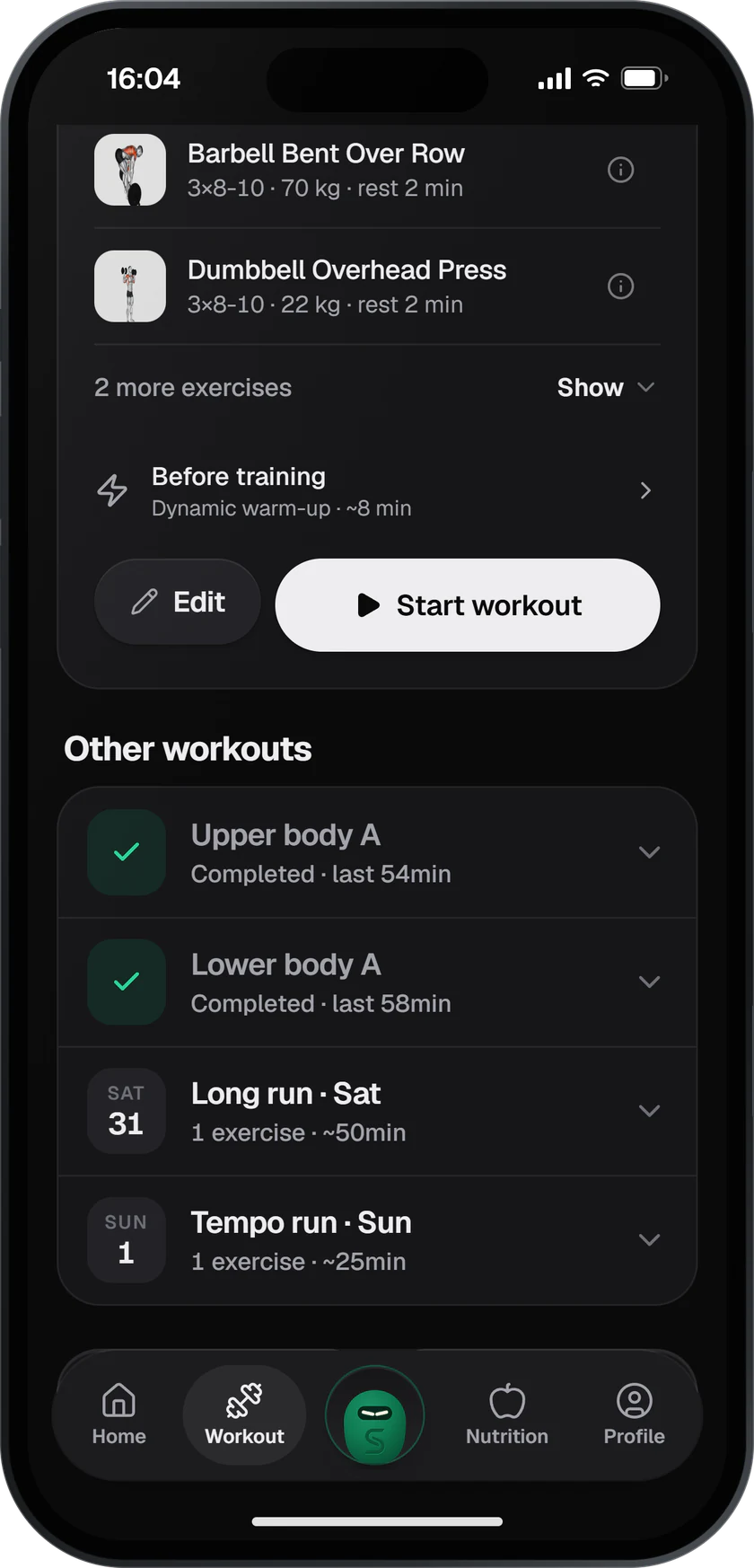
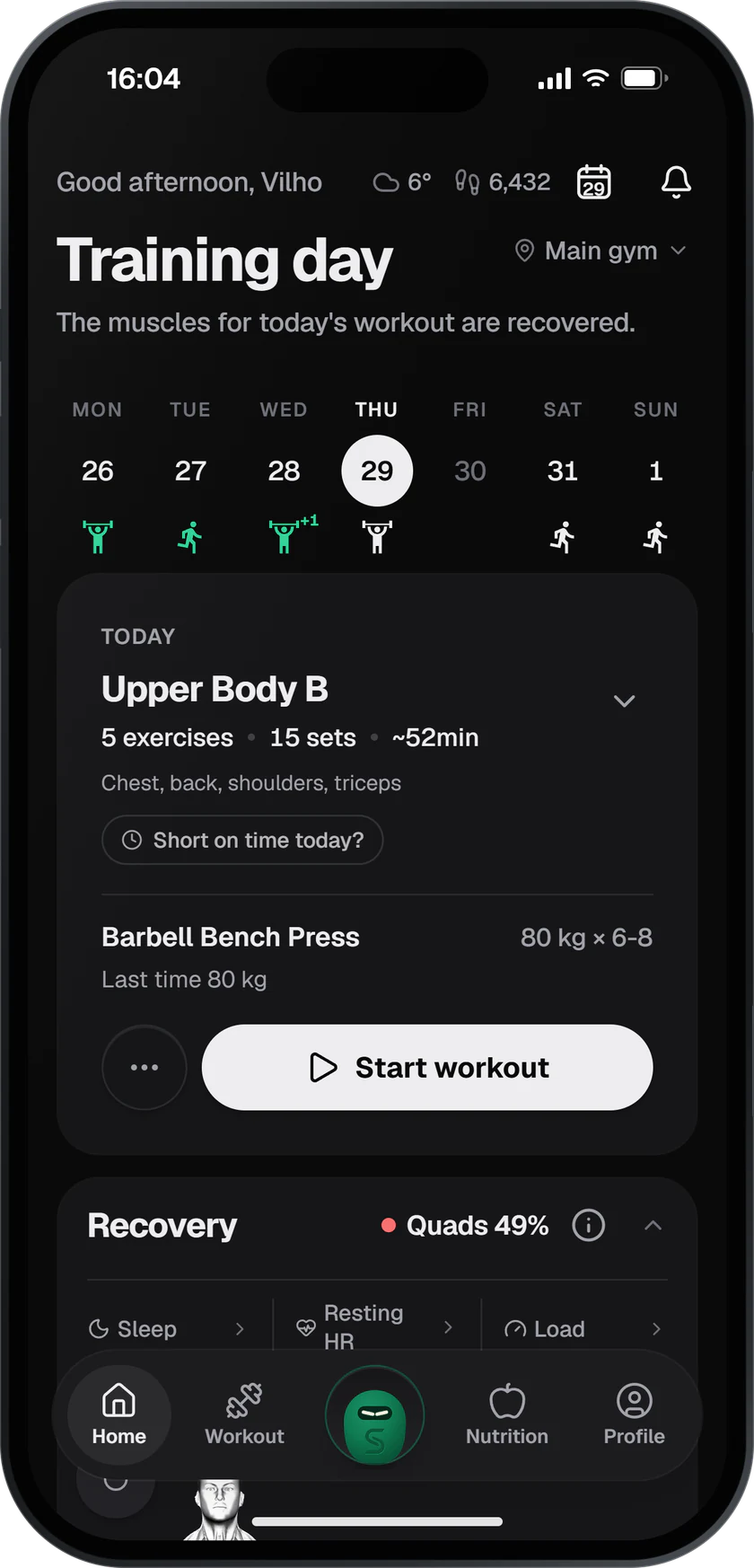
Gym days and runs in one program, and watch runs in the same week strip.
You raise running volume yourself following principle 5: one rising load at a time. Adding runs to your program, importing watch workouts and measured recovery are part of Premium and work in the 14 day free trial.
Sources
- Hickson RC (1980). Interference of strength development by simultaneously training for strength and endurance. European Journal of Applied Physiology and Occupational Physiology.
- Wilson JM et al. (2012). Concurrent training: a meta-analysis examining interference of aerobic and resistance exercises. Journal of Strength and Conditioning Research.
- Schumann M et al. (2022). Compatibility of Concurrent Aerobic and Strength Training for Skeletal Muscle Size and Function: An Updated Systematic Review and Meta-Analysis. Sports Medicine.
- Petré H et al. (2021). Development of Maximal Dynamic Strength During Concurrent Resistance and Endurance Training in Untrained, Moderately Trained, and Trained Individuals. Sports Medicine.
- Huiberts RO, Wüst RCI, van der Zwaard S (2024). Concurrent Strength and Endurance Training: A Systematic Review and Meta-Analysis on the Impact of Sex and Training Status. Sports Medicine.
- Murlasits Z, Kneffel Z, Thalib L (2018). The physiological effects of concurrent strength and endurance training sequence: A systematic review and meta-analysis. Journal of Sports Sciences.
- Eddens L, van Someren K, Howatson G (2018). The Role of Intra-Session Exercise Sequence in the Interference Effect: A Systematic Review with Meta-Analysis. Sports Medicine.
- Sabag A et al. (2018). The compatibility of concurrent high intensity interval training and resistance training for muscular strength and hypertrophy. Journal of Sports Sciences.
- Murach KA, Bagley JR (2016). Skeletal Muscle Hypertrophy with Concurrent Exercise Training: Contrary Evidence for an Interference Effect. Sports Medicine.
- Balsalobre-Fernández C et al. (2016). Effects of Strength Training on Running Economy in Highly Trained Runners: A Systematic Review With Meta-Analysis of Controlled Trials. Journal of Strength and Conditioning Research.
- Muñoz I et al. (2014). Does polarized training improve performance in recreational runners? International Journal of Sports Physiology and Performance.
- Rosenblat MA et al. (2025). Which Training Intensity Distribution Intervention will Produce the Greatest Improvements in Maximal Oxygen Uptake and Time-Trial Performance in Endurance Athletes? Sports Medicine.
- Jäger R et al. (2017). International Society of Sports Nutrition Position Stand: protein and exercise. Journal of the International Society of Sports Nutrition.
- Thomas DT, Erdman KA, Burke LM (2016). American College of Sports Medicine Joint Position Statement: Nutrition and Athletic Performance. Medicine & Science in Sports & Exercise.
→ Read also: Running and strength training in the same week | All workout programs