



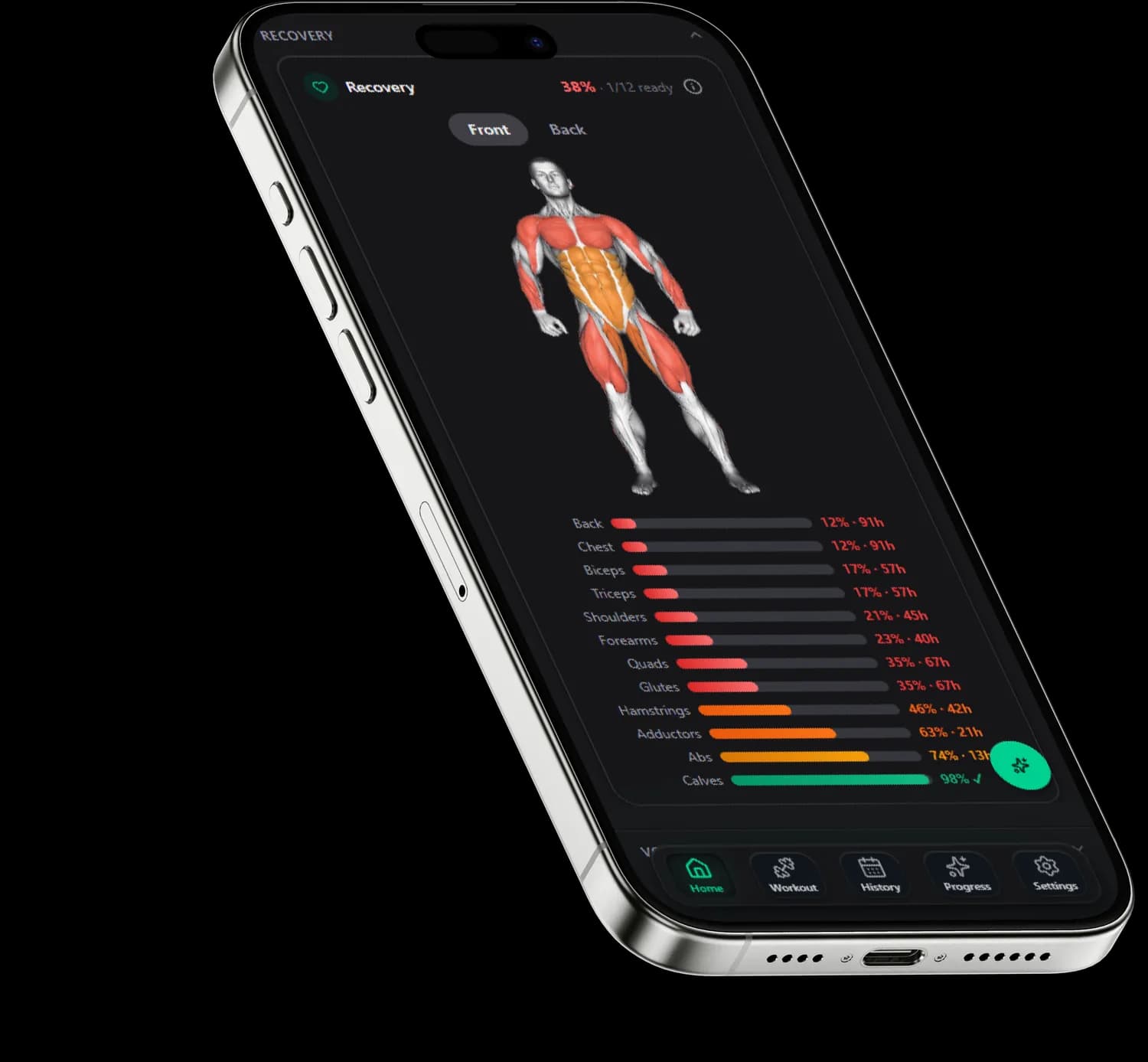
If you also want to know how much to eat, the calorie calculator works out your calorie needs and macros for your goal.
How max heart rate and zones are calculated
Max heart rate is estimated with the Tanaka formula 208 − 0.7 × age (Tanaka, Monahan & Seals 2001), which research shows to be more accurate than the old 220 − age, especially over 40. The formula still has a spread of about 10 beats, so a measured max is always better.
Heart rate zones are percentages of max heart rate. If you enter a resting heart rate, the calculator uses the Karvonen formula: heart rate = resting + percentage × (max − resting). It accounts for fitness, because a fit person's low resting rate raises the zone floors closer to the true load.
What the heart rate zones mean
Zone 1 is recovery movement and warm-up. Zone 2 is base endurance, where you can speak full sentences: most endurance training belongs here. Zone 3 is tempo and aerobic power, zone 4 threshold and intervals, zone 5 short maximal efforts.
In strength training, heart rate is a poor measure of load: a heavy set spikes the heart rate briefly into zone 4 while the metabolic load is small. In the gym, heart rate zones are mainly used to guide warm-up and recovery cardio.
How to use heart rate zones
A split that works for gym-goers is 80 percent of endurance training in zones 1-2 and 20 percent in zones 4-5. Zone 3 is tempting because it feels effective, but it tires more than it builds if there is a lot of it.
Measure your resting heart rate in the morning for a few weeks. A rise of 5-10 beats above normal signals incomplete recovery or the start of an illness, and then a hard session is worth moving. SisuLift makes this call automatically from watch data.
Frequently asked questions
How is max heart rate calculated?
The most accurate way is to measure it in a hard uphill interval or a test. Of the formulas, Tanaka's 208 − 0.7 × age is more accurate in research than 220 − age, but both have an individual spread of about 10 beats. For a 40-year-old Tanaka gives 180.
What is the Karvonen formula?
The formula presented by Finnish physiologist Martti Karvonen in 1957 calculates heart rate zones from heart rate reserve, the difference between max and resting heart rate: target = resting + percentage × (max − resting). It accounts for fitness, because a low resting rate raises the zones.
What is zone 2 and why does everyone talk about it?
Zone 2 is 60-70 percent of max, a pace where you can speak in sentences. It builds base endurance and fat metabolism without excessive fatigue, so most endurance training should happen there. For a gym-goer, 2-3 × 30-45 minutes a week is enough.
Do heart rate zones work for strength training?
Poorly. A heavy set spikes the heart rate briefly even though the metabolic load is small, and rests bring it down fast. In the gym, load is better measured with RIR and total volume. Heart rate suits guiding warm-up and recovery cardio.
Why do my watch's zones differ from the calculator?
Watches use a different max heart rate formula or a measured max, and some compute zones from heart rate reserve. If you know your true max, set it in the watch manually. The calculator's zones are a starting point; measured data refines them.