


Exercises · Quadriceps · Updated
Leg extension
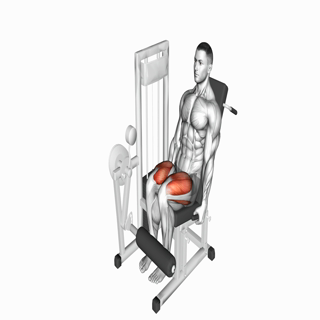
The leg extension is a quad isolation exercise. You sit in the machine and straighten your knees against resistance, so the quadriceps do almost all the work. It is the only common gym exercise that loads the quads without the hips and back taking part.
- Primary muscle
- Quadriceps
- Equipment
- Machine
- Variations
- 3 exercise pages
Leg extension: variations and what they target
The variations differ in whether you work both legs or one and whether the load comes from a stack or from plates. The single-leg version is a good way to even out side-to-side differences, and stack and plate-loaded machine weights are not worth comparing, because the resistance is distributed differently.
- Lever Leg ExtensionThe standard two-leg version. You can add load steadily, and the movement is easy to learn. Set the backrest and pad once and note the settings down, so every session starts from the same position.
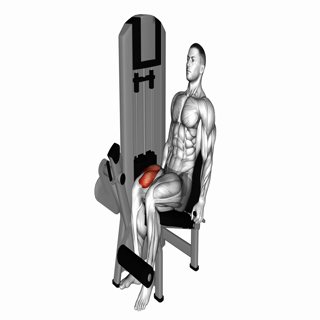 Lever One Leg ExtensionOne leg at a time. Reveals side-to-side differences and lets you focus on the weaker leg. Start with the weaker leg and match the reps with the stronger one.
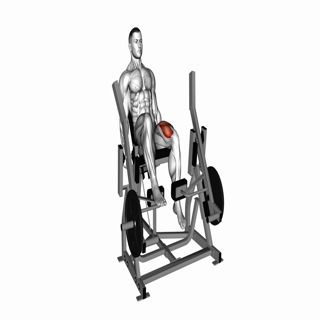 Lever Single Leg Extension (plate loaded)On a plate-loaded machine the resistance is often more even across the range. Weights cannot be compared with a stack machine.
Sets and reps by goal
These are the numbers SisuLift uses when it programs this exercise. Sets come from the app's program templates and reps from the range inside which the app increases the weight.
| Goal | Sets | Reps | Effort | Rest |
|---|---|---|---|---|
| Strength | 2–3 | 8–12 | RPE 8–9 | 1.5 min |
| Muscle growth | 3 | 10–15 | RPE 7–8 | 1.5 min |
| General fitness and fat loss | 3 | 10–15 | RPE 7–8 | 1.5 min |
RPE describes how hard a set is on a scale of 1–10. RPE 8 means you would still have about two reps left.
When every set reaches the top of the range, SisuLift raises the weight by one equipment step next time and the reps drop back to the bottom of the range. In a calorie deficit the range stays the same, because that is when you want to keep your loads.
Leg extension in your program
The leg extension fits the end of a leg day after the squat or leg press. You can also use light sets as a warm-up before squats when your knees need time to warm up.
Around 10–20 sets a week is enough for most people's quads, and the leg extension can be 2–4 of them. The machine is a good place for slow lowering phases and pauses, because the weight cannot fall on you.
SisuLift raises the weight by one machine step when every set reaches the top of the rep range. If the machine's step is big, your reps return to the bottom of the range and you build up from there.
If your knee is sensitive, start with a smaller range and lighter weight and widen the range gradually. Many machines let you limit the range with an adjustment. Slow reps and a pause at the top load the quads well without heavy weight.
At home without the machine, a seated knee extension on a chair with a resistance band around your ankle loads the same muscle, even though the load stays lighter. It does not replace the machine, but it works well as a light complement.
Technique essentials
- Adjust the backrest so your knee lines up with the machine's pivot, and the pad sits just above your ankle. Hold the side handles.
- Straighten your knees almost fully and hold the top briefly so you feel your quads contract.
- Lower under control for about two seconds as deep as the machine allows before starting the next rep.
Most common mistakes
Swinging the weight up. When you kick the weight up with momentum and drop it, the quads work only briefly. A controlled lowering phase builds muscle, so reduce the weight if you cannot brake it.
Hips lifting off the seat. When the set gets hard, many lift their glutes off the seat, which changes the angle. Hold the handles and press your back against the backrest.
The backrest in the wrong position. If your knee does not line up with the machine's pivot, the pad slides along your shin and the load hits the knee awkwardly. Adjust the backrest and ankle pad before the first set every time and note the settings down.
Frequently asked
What muscles does the leg extension work?
The quads, the quadriceps, whose four parts all extend the knee. The rectus femoris also attaches to the pelvis, and in a comparison study the leg extension grew it better than the squat. Other muscles barely take part.
What is the leg extension called in Finnish?
In Finnish the leg extension is reiden ojennus or polven ojennus laitteessa, and some gyms call the machine etureisilaite. The matching hamstring exercise is the leg curl, reiden koukistus in Finnish.
Is the leg extension bad for your knees?
Not for healthy knees. The exercise loads the knee in a controlled way and is also used in rehabilitation. If your knee has been operated on or hurts, agree on the range of motion and load with a physiotherapist. Muscle fatigue is normal, but you should not feel pain.
Should you turn your toes in or out?
No need. Turning your toes changes the emphasis between the inner and outer quads only slightly. Keep your toes pointing up or slightly out, whichever feels natural for your knee, and focus on full range of motion.
Can the leg extension replace the squat?
No, but it complements the squat well. The squat builds the glutes, adductors and core as well as the quads, while the leg extension fatigues the quads without your back or balance limiting you. If you cannot squat, the leg press and leg extension together replace it well for muscle growth.
How many sets and reps of leg extensions?
For muscle growth 3 sets of 10–15 reps, with about 1.5 minutes of rest between sets. An isolation exercise does not need heavy strength sets. Take the last set close to failure, because on a machine it is safe.