

Exercises · Chest · Updated
Cable fly
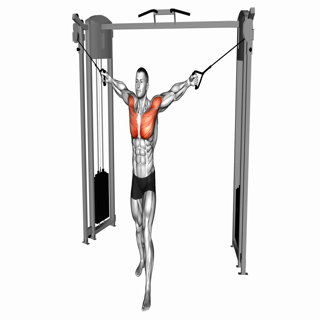
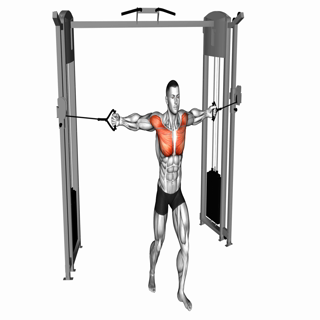
The cable fly, or cable crossover, is a chest isolation exercise where you bring the handles of two cables together in front of your body. Thanks to the cables, tension stays on the chest throughout the range, including the end position where dumbbells already go light. The handle height lets you choose which part of the chest works hardest.
- Primary muscle
- Chest
- Assisting muscles
- Shoulders
- Equipment
- Cable
- Variations
- 6 exercise pages
Cable fly: variations and what they target
The variations differ mainly in the line of pull. Pulling from high to low emphasises the lower chest, low to high the upper chest and the middle the whole muscle.
- Cable Middle FlyHandles at shoulder height. You bring your hands together in front of your chest, and the whole chest works evenly. A good standard version. When learning the movement, start here and move to other lines of pull later.
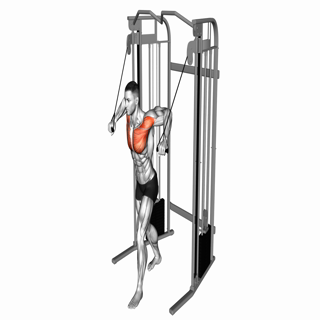 Cable High FlyHandles high and the pull diagonally down toward the hips. Emphasises the middle and lower chest. Many feel this version best in the chest.
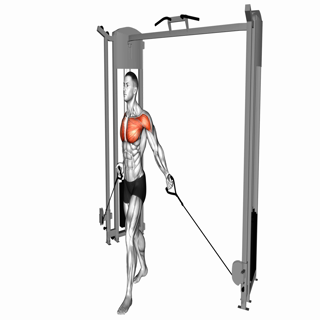 Cable Low FlyHandles low and the pull diagonally up toward the chin. Emphasises the upper chest, and the shoulders stay lightly loaded.
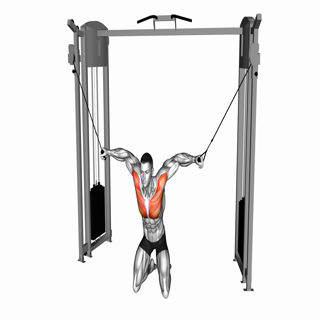 Cable Kneeling High to Low FlyKneeling, from high to low. Your hips and legs cannot help, so there is no swinging and the chest does the work. Works well at the end of a session when your legs are already tired.
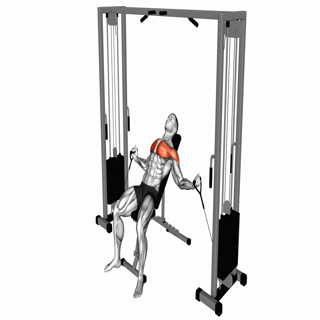 Cable Incline FlyOn an incline bench between the cables. The bench supports your back, and the lift emphasises the upper chest like the incline bench press.
Sets and reps by goal
These are the numbers SisuLift uses when it programs this exercise. Sets come from the app's program templates and reps from the range inside which the app increases the weight.
| Goal | Sets | Reps | Effort | Rest |
|---|---|---|---|---|
| Strength | 2–3 | 8–12 | RPE 8–9 | 1.5 min |
| Muscle growth | 3 | 10–15 | RPE 7–8 | 1.5 min |
| General fitness and fat loss | 3 | 10–15 | RPE 7–8 | 1.5 min |
RPE describes how hard a set is on a scale of 1–10. RPE 8 means you would still have about two reps left.
When every set reaches the top of the range, SisuLift raises the weight by one equipment step next time and the reps drop back to the bottom of the range. In a calorie deficit the range stays the same, because that is when you want to keep your loads.
Cable fly in your program
The cable fly fits the end of a chest session after the bench press or chest press. Light sets also work as a warm-up so your shoulder and chest are ready for heavy presses.
Around 10–20 sets a week is enough for most people's chest, and fly movements can be three to six of them. Choose one line of pull, and change it only if you want to emphasise the upper chest.
Cable stack increments are often large for this exercise. SisuLift raises the weight by one step when every set reaches the top of the rep range, and your reps then return to the bottom of the range.
If your shoulder bothers you in presses, the cable fly is often a friendlier way to load the chest, because the load is light and you can choose the line of pull to suit your shoulder. Try the low-to-high version, where the shoulder stays lower, and keep the range pain-free.
Technique essentials
- Stand in the middle of the cables one step forward, one foot in front. Lean your upper body slightly forward and keep your elbows slightly bent.
- Bring your hands together in an arc in front of your body as if hugging a big tree. The elbow angle stays the same throughout.
- Return under control until you feel a stretch in your chest, but do not let your shoulders roll forward.
Most common mistakes
Bending and straightening the elbows. When your elbows bend during the pull, the movement turns into a press and the triceps do part of the work. Lock your elbow angle and think of the movement coming from your shoulders.
Too much weight and swinging. When the load pulls you back and you swing it together with your body, the chest gets little work. Choose a weight you can control for 10–15 reps.
Shoulders rolling forward. When your hands come together and your shoulders drop forward, the front delt takes the work from the chest. Keep your chest up and shoulder blades back throughout, including the end position.
Frequently asked
What muscles does the cable fly work?
The pectoralis major, which brings the upper arm toward the midline of the body. The front delt assists, and the biceps hold the elbow angle. Unlike in presses, the triceps barely take part, so you can fatigue the chest without the triceps giving out first.
What height should the cable fly handles be?
For the upper chest set the handles low and pull upward, for the middle at shoulder height, and for the lower chest high and pull downward. For muscle growth one height is enough if you also do a press. Vary the height if you want to emphasise the upper chest.
Cable fly or pec deck?
Both are chest fly movements. The pec deck guides the path and supports your back, so it is easier to learn and load. With cables you can adjust the line of pull and move more freely, but body position takes more control. Choose the one where you feel your chest better.
Cable fly or dumbbell fly?
With dumbbells the load is heaviest at the bottom in the stretch and drops almost to zero when your arms are up. With cables the tension stays throughout the range. Both build the chest, so use whichever is free in your gym and feels good in your shoulder.
Should you keep your elbows straight?
No. Keep your elbows slightly bent and lock the angle for the whole movement. Fully straight elbows load the elbow joint and the biceps tendon, and too much bend turns the movement into a press.
How many sets and reps of cable flies?
For muscle growth 3 sets of 10–15 reps, with about 1.5 minutes of rest between sets. A fly movement does not need heavy strength sets, because the load stays small. Take the last set close to failure and hold the end position for a second.