

Exercises · Back · Updated
Bent-over row
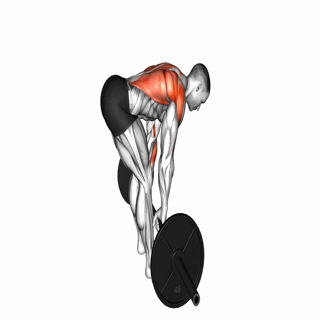
The bent-over row is a basic back exercise where you hinge forward and row a barbell or dumbbells towards your stomach. It builds the lats, the muscles between the shoulder blades and the rear delts, while the lower back and hamstrings hold the position. As a pull you can load heavily, it complements the lat pulldown and the pull-up.
- Primary muscle
- Back
- Assisting muscles
- Biceps, Lower Back, Forearm
- Equipment
- Barbell, Dumbbell, Machine
- Variations
- 8 exercise pages
Bent-over row: variations and what they target
The variations differ in equipment, grip and how much the lower back has to support. Supported versions remove the load from the lower back, free versions also build position control.
- Barbell Bent Over RowThe base version. Overhand grip wider than the shoulders, torso at about 45 degrees, and the bar is pulled to between the navel and the lower chest. You can load it the heaviest.
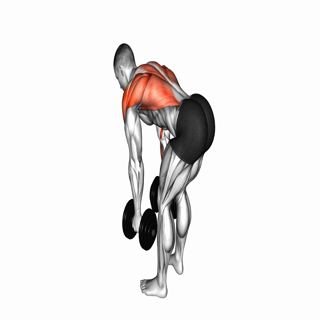 Dumbbell Bent over RowBoth arms at the same time. Dumbbells give a freer path and a longer movement than a barbell, which stops at the stomach.
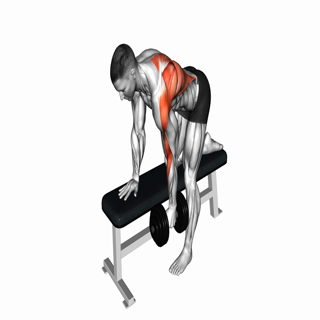 Dumbbell Bent Over Single Arm RowOne hand and knee on a bench for support. The lower back rests, and you can focus on the stretch and the shoulder blade pull one side at a time.
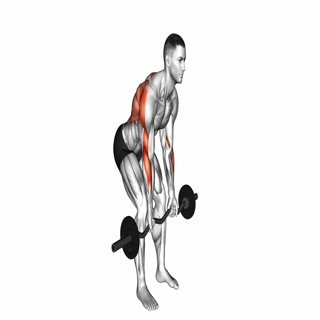 Barbell Row (Underhand)With an underhand grip the elbows travel close to the sides, and the biceps and lats do more work. Many people can row a little more with an underhand grip.
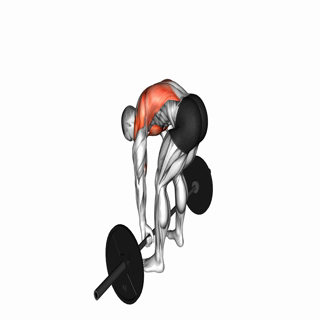 Barbell Pendlay RowEvery rep starts from a dead stop on the floor, with the torso nearly horizontal. An explosive pull without momentum, popular in strength training.
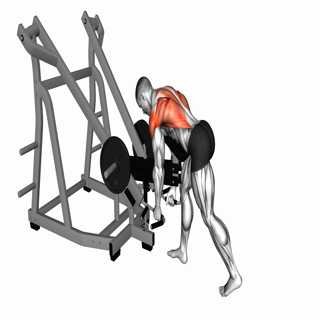
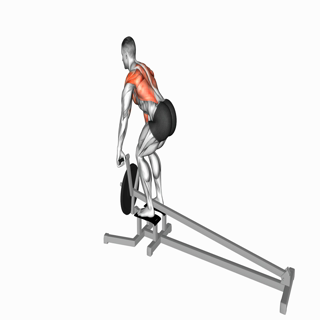
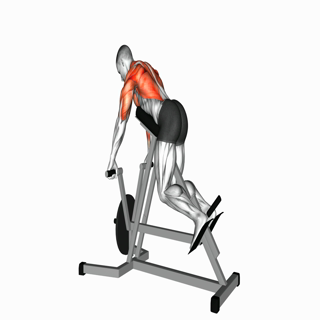 Lever Lying T-bar RowChest-supported T-bar row on a machine. The lower back isn't loaded, so you can tire the back heavily and safely.
Sets and reps by goal
These are the numbers SisuLift uses when it programs this exercise. Sets come from the app's program templates and reps from the range inside which the app increases the weight.
| Goal | Sets | Reps | Effort | Rest |
|---|---|---|---|---|
| Strength | 3–4 | 4–6 | RPE 8–9 | 2.5 min |
| Muscle growth | 3–4 | 8–12 | RPE 7–8 | 2.5 min |
| General fitness and fat loss | 3–4 | 8–12 | RPE 7–8 | 2.5 min |
RPE describes how hard a set is on a scale of 1–10. RPE 8 means you would still have about two reps left.
When every set reaches the top of the range, SisuLift raises the weight by one equipment step next time and the reps drop back to the bottom of the range. In a calorie deficit the range stays the same, because that is when you want to keep your loads.
Bent-over row in your program
The bent-over row fits at the start of a back day or an upper body workout, because with a barbell it also loads the lower back and hamstrings. If you do heavy deadlifts on the same day, choose a chest-supported or one-arm variation for your rows, so your lower back doesn't get tired twice.
For most people about 10–20 sets a week for the back is enough, and the bent-over row can be three to four of those sets per session. Combine it with a vertical pull such as the lat pulldown or the pull-up, so the back is loaded in both directions.
With a barbell the load in the bent-over row goes up quickly, but the technique often fails before the muscles do. If your torso starts to rise during the set, stay at the same weight and make the reps stricter. SisuLift tracks the weights for each variation separately, so switching to a supported version doesn't mess up your history.
Technique essentials
- Stand with feet hip width apart and knees slightly bent, and hinge forward from the hips with a straight back.
- Pull the bar towards your lower stomach by driving the elbows back and squeezing the shoulder blades together.
- Lower under control until your arms are straight. Keep the torso angle the same for the whole set.
Most common mistakes
The torso rising upright during the set. When the angle changes every rep, the movement turns into a swing and the back does little work. Lighten the weight or switch to a chest-supported variation if your lower back tires before your upper back.
The back rounding during the set. When the lower back rounds under a heavy load, the upper back doesn't do its job properly and the lower back has to carry the load in a poor position. Brace your core before every rep and keep your gaze slightly forward and down.
Frequently asked
What does the bent-over row target?
The whole upper back: the lats, the rhomboids between the shoulder blades, the middle and lower traps and the rear delts. The biceps and forearms assist. The lower back, glutes and hamstrings do holding work to keep the torso at an angle.
What muscles does the barbell bent-over row work?
The same as other bent-over rows, but the barbell allows the heaviest load, so the lower back and hamstrings also work the hardest. A wide overhand grip emphasises the upper back and rear delts, a closer or underhand grip more the lats. If your lower back limits you, do the heavy sets chest-supported.
Is the seated cable row the same as the bent-over row?
Not quite. Both are horizontal pulls, but in the seated cable row you sit with your feet braced, so the lower back load is small. In the bent-over row you hold the torso angle yourself, which also loads the lower back and hamstrings. They build the upper back in a similar way and can stand in for each other.
What muscle does the one-arm row target?
The lats and the muscles between the shoulder blades, with the rear delts and biceps assisting. Because one hand supports you, the lower back rests and you can use a long range of motion. Pulling the elbow towards your hip makes the lats work more. Pulling it out to the side brings the upper back and rear delts forward.
What is a T-bar row?
The T-bar row is a bent-over row variation where one end of the bar is fixed to the floor and you pull the other end with a handle. The path is curved and the grip neutral, which suits many people well. On the machine your chest is supported, so the lower back isn't loaded and you can train the back heavily.
What are the benefits of the bent-over row?
The bent-over row strengthens the upper back and shoulder blade control, which balances the load from pressing exercises and supports good posture. It builds back muscle and develops the pulling strength you need in the deadlift and the pull-up, for example. Done free-standing, it also teaches you to keep a neutral back under load.