
Rules checked against Andy Frisella's official guide on 26 September 2026
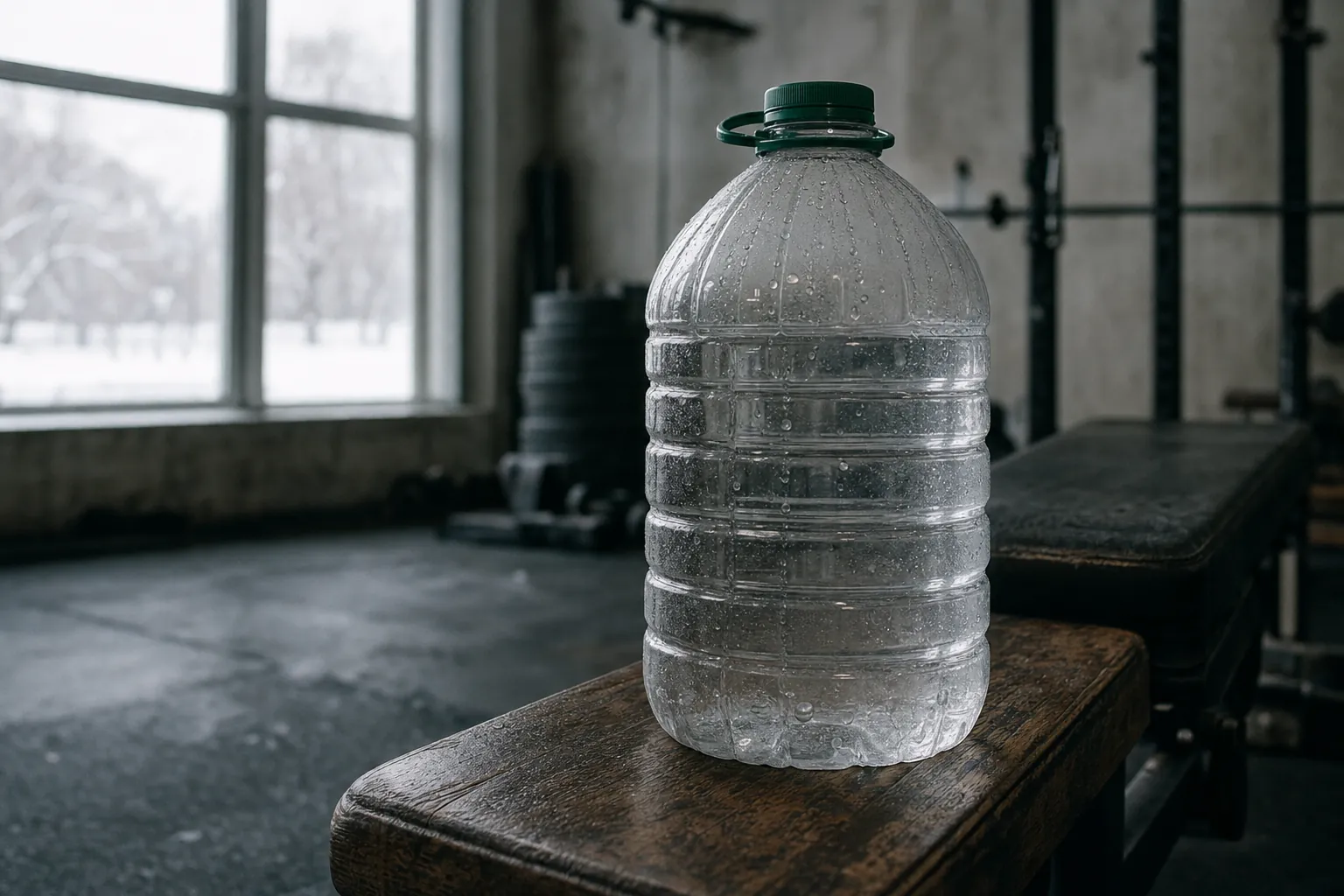
Short answer: 75 Hard is Andy Frisella's 75-day challenge with five daily tasks: two workouts of at least 45 minutes (one of them outdoors), a diet of your choice with no cheat meals and no alcohol, a gallon of water (about 3.8 litres), 10 pages of a non-fiction book and a progress photo. Miss a single task and you restart from day 1. Frisella calls it a mental toughness program, not a fitness challenge. It does build routine, but the restart rule clashes with what habit research shows: missing one day does not derail a habit. Below you get the rules in a table, an honest assessment and a 75-day version that leaves you with a training habit rather than a survival story.
75 Hard rules: five tasks every day
Frisella's official guide is short, and that is exactly why it leaves no wiggle room. The table puts the rules in plain words, and the right-hand column shows what each one means in normal life.
The 75 Hard rules in plain words (source: Andy Frisella's official guide)
| Rule | What it requires | In practice |
|---|---|---|
| Two workouts | 2 × at least 45 min every day. One outdoors whatever the weather, with at least 3 hours between them. | 90 minutes a day is 630 minutes a week. The WHO recommends 150-300 minutes of moderate activity a week for adults, plus strength training on at least two days. |
| Diet | A diet of your choice for 75 days with zero exceptions. No cheat meals, no alcohol. | The rule does not say what to eat, only that you never deviate. That includes birthdays, holidays and work drinks. |
| Water | One gallon, about 3.8 litres of water a day. | EFSA's adequate intake for total water, including water from food, is 2.0 litres for women and 2.5 litres for men. |
| Reading | At least 10 pages of a non-fiction or educational book a day. Audiobooks do not count. | Roughly 10-20 minutes a day. The only rule that puts no load on your body. |
| Progress photo | A photo of yourself every day. | You will not see change from one day to the next. Compare photos weeks apart. |
| If you slip | Miss one task and the challenge restarts from day 1. | A forgotten photo on day 60 wipes out 59 completed days. |
Two clarifications. The diet is not specified: you pick it yourself, whether that is a calorie deficit, vegetarian eating or your own meal plan, as long as you never deviate from it. The type of workout is not restricted either. According to the official guide running, lifting, walking or yoga all count, as long as you move with the intent to get better. Frisella's own page also tells you to talk to a doctor before you start.
What 75 Hard actually does for you
There is no peer-reviewed research on the challenge itself: PubMed has no publication on 75 Hard (searched 26 September 2026). So this assessment is based on what exercise, nutrition and habit research says about its parts. First, what works.
What works
- Clarity. Five yes-or-no tasks are easy to track, and you never have to negotiate with yourself during the day.
- Movement every day. When exercise is part of every day, it stops being a separate decision.
- A visible finish line. 75 days is short enough to start and long enough to leave a mark.
- A break from alcohol. 75 days without drinking is a good thing for almost anyone, and it needs no fitness justification.
Where it falls short
- All or nothing. A forgotten photo on day 60 wipes out 59 completed days. The rule measures discipline, but it also teaches you that a single slip equals failure. In light of habit research that is the wrong lesson, more on that in the next section.
- No rest days. 75 days means 150 workouts without a single day off. Walks are easy to recover from, but if both workouts are hard, recovery falls behind and the risk of overuse injuries goes up.
- No measure of progress. The rules count minutes, not results. The same 45-minute walk ticks the box from day 1 to day 75, but it will not make you stronger. In the gym, progress comes from adding weight or reps week by week, in other words progressive overload.
- The same water target for everyone. A gallon is a unit of measurement, not an individual need. A 55 kg person and a 110 kg person drink the same 3.8 litres.
- A rigid diet. A diet you may never deviate from is exactly the kind of rigid control that a cross-sectional study linked to eating disorder symptoms. Flexible control was not (Stewart et al. 2002).
What research says about how habits form
The best-known study on habit formation is the follow-up by Phillippa Lally and colleagues (2010, European Journal of Social Psychology). 96 adults picked one daily eating, drinking or activity behaviour done in the same context, for example after breakfast. For 12 weeks they rated every day how automatic it felt. In the 39 participants whose data fitted the model well, automaticity reached 95 percent of its personal peak after a median of 66 days. The range was 18-254 days.
For 75 Hard the key finding is a different one: missing a single opportunity did not materially affect habit formation. Consistency mattered, not a perfect streak. The more consistently people repeated the behaviour, the more clearly the habit developed along the expected curve.
A 2024 systematic review and meta-analysis (Singh et al., Healthcare) pooled 20 studies with 2,601 participants. Forming a health habit took a median of 59-66 days and a mean of 106-154 days, with individual variation from 4 to 335 days. Two months is a realistic start, not the finish line.
For exercise there is an even more direct result. Kaushal and Rhodes followed 111 new gym members for 12 weeks (2015, Journal of Behavioral Medicine). Building an exercise habit took at least four sessions a week for six weeks, and the habit was predicted by consistency, keeping the exercise simple, the environment and actually enjoying it.
What this means for 75 Hard: 75 days is a well-chosen length because it exceeds the median in habit studies. The restart rule, however, punishes exactly the thing research says does not hurt, and it can tempt you to quit altogether, because going back to day 1 feels heavier than carrying on from day 43. A better rule fits in one sentence: never miss twice in a row.
SisuLift data: a steady start predicts who keeps going
We looked at SisuLift, a Finnish gym app, to see what predicts that someone starting out in the gym is still training three months later. The data covers 197 users whose first gym session logged in the app took place between 8 January and 4 July 2026. We grouped them by how many gym sessions they did in their first two weeks and checked whether they still did at least one gym session in weeks 9-12.
Sessions in the first two weeks and training in weeks 9-12 (n = 197)
| Gym sessions in the first 2 weeks | Users | Still training in weeks 9-12 |
|---|---|---|
| 1-3 | 79 | 23% |
| 4 or more | 118 | 76% |
- The gap held at every experience level. When users were split by their own reported level into beginners, intermediate, advanced and expert lifters, 71-82 percent of those with four or more sessions were still training in weeks 9-12. Among those with one to three sessions, 15-29 percent were.
- The bar is low. Four sessions in two weeks means two a week. 75 Hard racks up 28 workouts in the same time.
- This is a correlation, not cause and effect. People who train more often at the start may simply be more motivated or have more time. The sample is also small and only covers people who use the app.
The takeaway is still useful: what predicts sticking with it is building a rhythm in the first two weeks, not how hard you go at the start. It lines up with Kaushal and Rhodes, where consistency predicted the habit.
75 Soft and other lighter versions
75 Soft has no official rule list from a single author. Its most common form goes like this: eat nutritious food and drink alcohol only on social occasions, exercise 45 minutes a day with one active recovery day a week, drink 3 litres of water and read 10 pages of any book. That is how a clinical exercise physiologist at Penn State Health describes it, for example.
Other lighter versions circulate under different names, but none has an established rule list. The structure is always the same: less training, rest built in and flexibility with food. Below, 75 Hard and 75 Soft side by side, plus a version built for lifters that the next section walks through.
75 Hard, 75 Soft and a smarter 75 days side by side
| Area | 75 Hard | 75 Soft | Smarter 75 days |
|---|---|---|---|
| Training | 2 × 45 min every day, one outdoors | 45 min a day, one active recovery day a week | 3-4 gym sessions a week plus a daily walk |
| Food | Your own diet with zero exceptions, no alcohol | Nutritious food, alcohol only on social occasions | A daily protein target, the rest flexible |
| Water | About 3.8 litres | 3 litres | To thirst |
| Reading | 10 pages of non-fiction | 10 pages of any book | No rule |
| Tracking | A photo every day | Not part of the rules | Weights every session, body weight and a photo once a week |
| Sleep | No rule | No rule | At least 7 hours |
| Missed day | Restart from day 1 | No established rule | Carry on the next day, never miss twice in a row |
A smarter 75 days for lifters
If your goal is a gym habit that keeps going after day 75, keep the good parts of 75 Hard (clear daily tasks, a break from alcohol, a visible finish line) and change three things: training progresses week by week, rest is part of the plan, and a missed day resets nothing.
Every day
- Steps: 7,000-10,000. In a meta-analysis of 15 cohorts, mortality risk kept dropping as daily steps rose up to about 8,000-10,000 in adults under 60 and 6,000-8,000 in adults over 60 (Paluch et al. 2022). If you start from 4,000 steps, raise the target by about 1,000 steps a week.
- Protein: about 1.6 g per kg of body weight, roughly 130 g for an 80 kg person. In a meta-analysis, gains in muscle mass on average stopped increasing beyond that intake, and the authors consider about 2.2 g/kg a safe upper target for those who want every last bit (Morton et al. 2018). The protein calculator works out your number.
- Sleep: at least 7 hours a night. That is the joint recommendation for adults from the American Academy of Sleep Medicine and the Sleep Research Society (Watson et al. 2015).
- Water: drink to thirst. There is no need to chase a litre count, and on training days thirst tells you when you need more.
- Alcohol: if you want to keep one 75 Hard rule exactly as it is, keep this one.
Every week
3-4 gym sessions a week. Three full-body workouts are enough to progress, and a fourth is worth adding only once your recovery and schedule can handle it. Background and research: how often you should go to the gym. If you miss the outdoor workout from 75 Hard, add one longer walk or run outside each week.
A smarter 75 days: the gym phases
| Days | In the gym | Goal |
|---|---|---|
| 1-14 | 3 full-body workouts a week, 2-3 sets per exercise. Weights that leave 2-3 reps in reserve. | At least 4 sessions in two weeks and solid technique |
| 15-42 | 3-4 sessions a week. Once every set hits the top of the rep range, add weight next time. | Weights going up week by week |
| 43-49 | A lighter week if weights have stalled or you feel run down: same exercises, half the sets. | Recovery before the final block |
| 50-75 | Keep going the same way. In the last week, compare your weights to day 1. | Progress you can see in numbers that continues after day 75 |
A ready-made structure for the first weeks is the beginner gym program: an 8-week full-body plan with two workouts alternating three times a week.
When you miss a session: do it the next day or continue the program where you left off. Do not double up the next workout and do not start over. If you miss two in a row, adjust your weekly rhythm instead of blaming yourself.
How to do it with SisuLift
SisuLift builds a program for 2-6 sessions a week and calculates next week's weights from the sets you log: once you hit your reps, the weight goes up (how the weights go up automatically). With a flexible rhythm, workouts are not tied to weekdays, so a missed day does not pile up as a backlog, the next workout simply waits. Steps come from your phone or watch via Apple Health or Health Connect, and the Nutrition tab sets a protein target from your weight and goal. You can also replace it with your own number.
The free plan covers workout logging, automatic progression and deload weeks, steps and nutrition tracking with a protein target, and your program can have two training days, for example full-body workouts A and B. A larger program, progress photos and full use of the AI coach are part of Premium (€9.90 a month or €79.90 a year). The 14-day trial unlocks everything without a payment card.
Who should skip 75 Hard
75 Hard is not a medically designed program, and Frisella's own page tells you to ask a doctor before starting. In these situations, pick a lighter version or skip the challenge:
- A current or past eating disorder. A diet with zero exceptions and a daily body photo are exactly the kind of rigid control that can bring symptoms back. A flexible approach is safer, and it is worth discussing any change with your care team.
- Pregnancy and breastfeeding. Two workouts a day and a strict diet are not a sensible experiment during pregnancy or breastfeeding without a plan agreed with your midwife or doctor.
- Kidney or heart disease, a fluid restriction from your doctor or medication that affects fluid balance. In that case your doctor decides how much water you drink, not a challenge.
- Diabetes or other medication that affects blood sugar. Two workouts a day and a new diet can change how much medication you need, so agree on the changes with your care team.
- A recent injury or overuse symptoms. Without rest days an injury has no time to heal.
A separate note on water. A large volume of water in a short time can dilute the sodium in your blood too far (hyponatremia, often called water intoxication). In sport, the main cause is drinking beyond thirst during long exercise, and an international consensus statement recommends drinking to thirst (Hew-Butler et al. 2015). In practice: spread your water across the day, do not down litres at once after a workout, and seek care if you get nausea, a headache or confusion after drinking a lot.
Sources
- Frisella A. What is 75 HARD? Official guide, andyfrisella.com (published 16 February 2021, accessed 26 September 2026).
- Lally P, van Jaarsveld CHM, Potts HWW & Wardle J (2010). How are habits formed: Modelling habit formation in the real world. European Journal of Social Psychology 40(6):998-1009.
- Singh B, Murphy A, Maher C & Smith AE (2024). Time to form a habit: a systematic review and meta-analysis of health behaviour habit formation and its determinants. Healthcare 12(23):2488.
- Kaushal N & Rhodes RE (2015). Exercise habit formation in new gym members: a longitudinal study. Journal of Behavioral Medicine 38(4):652-663.
- Bull FC et al. (2020). World Health Organization 2020 guidelines on physical activity and sedentary behaviour. British Journal of Sports Medicine 54(24):1451-1462.
- EFSA Panel on Dietetic Products, Nutrition and Allergies (2010). Scientific Opinion on Dietary Reference Values for water. EFSA Journal 8(3):1459.
- Hew-Butler T et al. (2015). Statement of the Third International Exercise-Associated Hyponatremia Consensus Development Conference, Carlsbad, California, 2015. Clinical Journal of Sport Medicine 25(4):303-320.
- Stewart TM, Williamson DA & White MA (2002). Rigid vs. flexible dieting: association with eating disorder symptoms in nonobese women. Appetite 38(1):39-44.
- Paluch AE et al. (2022). Daily steps and all-cause mortality: a meta-analysis of 15 international cohorts. The Lancet Public Health 7(3):e219-e228.
- Morton RW et al. (2018). A systematic review, meta-analysis and meta-regression of the effect of protein supplementation on resistance training-induced gains in muscle mass and strength in healthy adults. British Journal of Sports Medicine 52(6):376-384.
- Watson NF et al. (2015). Recommended amount of sleep for a healthy adult: a joint consensus statement of the American Academy of Sleep Medicine and Sleep Research Society. Journal of Clinical Sleep Medicine 11(6):591-592.
- Penn State Health News (10 January 2024). The Medical Minute: 75 Hard, 75 Soft and how to keep your fitness resolutions.
→ Read also: How much protein per day? | All workout programs