


Your weight changes when you eat less or more than you burn. The calorie calculator shows how much that is for you.
How BMI is calculated
Body mass index is your weight in kilograms divided by your height in metres squared. For 180 cm and 80 kg: 80 / (1.8 × 1.8) = 24.7. The calculator rounds to one decimal and sets the category from the same number you see.
The formula goes back to the 1830s, when Belgian statistician Adolphe Quetelet was looking for the average person. It was built for studying populations, not for judging one person’s health, which is why it works best across large groups.
BMI categories and where the limits come from
The limits here follow the Finnish Current Care guideline on obesity (updated 2025), which matches WHO: normal weight 18.5-24.9, overweight 25-29.9, obesity 30-34.9, severe obesity 35-39.9 and morbid obesity 40 or more. Under 18.5 is underweight in the WHO classification.
The limits are the same for women and men. For people of Asian background health risks start lower, so the overweight limit is 23 and obesity 27.5. Children and teens have their own BMI that adjusts for age and sex.
Why BMI misleads people with a lot of muscle
BMI doesn’t know what your weight is made of. Muscle is denser than fat, so someone who has lifted for years can weigh as much as an overweight person of the same height without a gram of extra fat. At 180 cm and 92 kg, BMI calls you overweight (28.4) whether your waist is 84 or 104 cm.
The same error works the other way too. A person of normal weight can carry fat around the middle, and then BMI gives false comfort. Researchers call this normal weight central obesity.
That’s why this calculator asks for your waist. For anyone who trains, waist, body fat percentage and strength say more than BMI.
Your waist tells what BMI doesn’t
According to the Finnish Current Care guideline and THL, abdominal obesity starts above 100 cm for men and above 90 cm for women. Fat around the middle is linked to type 2 diabetes, high blood pressure and cardiovascular disease (NICE).
The UK’s NICE also recommends the waist-to-height ratio: keep your waist under half your height. Under 0.5 is healthy, 0.5-0.59 is increased risk and 0.6 or more is high risk. NICE says the ratio works for adults with a BMI under 35, including people with a lot of muscle.
Measure standing, halfway between your lowest rib and the top of your hip bone, at the end of a relaxed breath out. Keep the tape level and don’t pull it tight. Use the same spot and time of day so your measurements compare.
How to use your result
If both BMI and waist are in the healthy range, there’s no reason to worry about your weight. Training, sleep and food matter more than decimals.
If BMI is raised but your waist isn’t, the weight is most likely muscle, and body fat and strength are better measures. If both are raised, the calorie deficit calculator gives a realistic timeline and the ideal weight calculator shows what the formulas say about your height.
Sources
- Finnish Current Care guideline: Obesity (children, adolescents and adults), 17 April 2025 (in Finnish)
- THL Healthy Finland survey 2023: obesity (in Finnish)
- NICE NG246: Identifying and assessing overweight, obesity and central adiposity
- WHO: Malnutrition in women (BMI cut-offs)
Frequently asked questions
What is BMI?
BMI, or body mass index, is your weight relative to your height. It’s the most common way to check whether an adult’s weight is in a healthy range. Normal weight is a BMI of 18.5-24.9.
How is BMI calculated?
Divide your weight in kilograms by your height in metres squared. 70 kg and 170 cm: 70 / (1.7 × 1.7) = 24.2. The calculator does the same and also shows your category and the normal weight range for your height.
What is a normal BMI?
18.5-24.9. For someone 175 cm tall, that means roughly 56.7-76.3 kg. The range is the same for women and men.
Why does BMI say I’m overweight when I lift?
BMI can’t tell muscle from fat. Someone who trains strength weighs more than an untrained person of the same height, even with less fat. Your waist-to-height ratio or body fat percentage shows which one your weight is.
What is a healthy waist size?
The Finnish Current Care limit for abdominal obesity is above 100 cm for men and above 90 cm for women. A simpler rule of thumb is NICE’s: keep your waist under half your height, so under 90 cm if you’re 180 cm.
Are BMI limits different for women and men?
No. BMI categories are the same for all adults. The difference is in waist size: the abdominal obesity limit is 90 cm for women and 100 cm for men.
Does BMI work for children and older adults?
Not for children and teens, who use a BMI that adjusts for age and sex. In older adults BMI is harder to read anyway, since muscle mass drops and height can shrink with age. Strength and waist size tell more there.
Can I track my weight and waist in SisuLift?
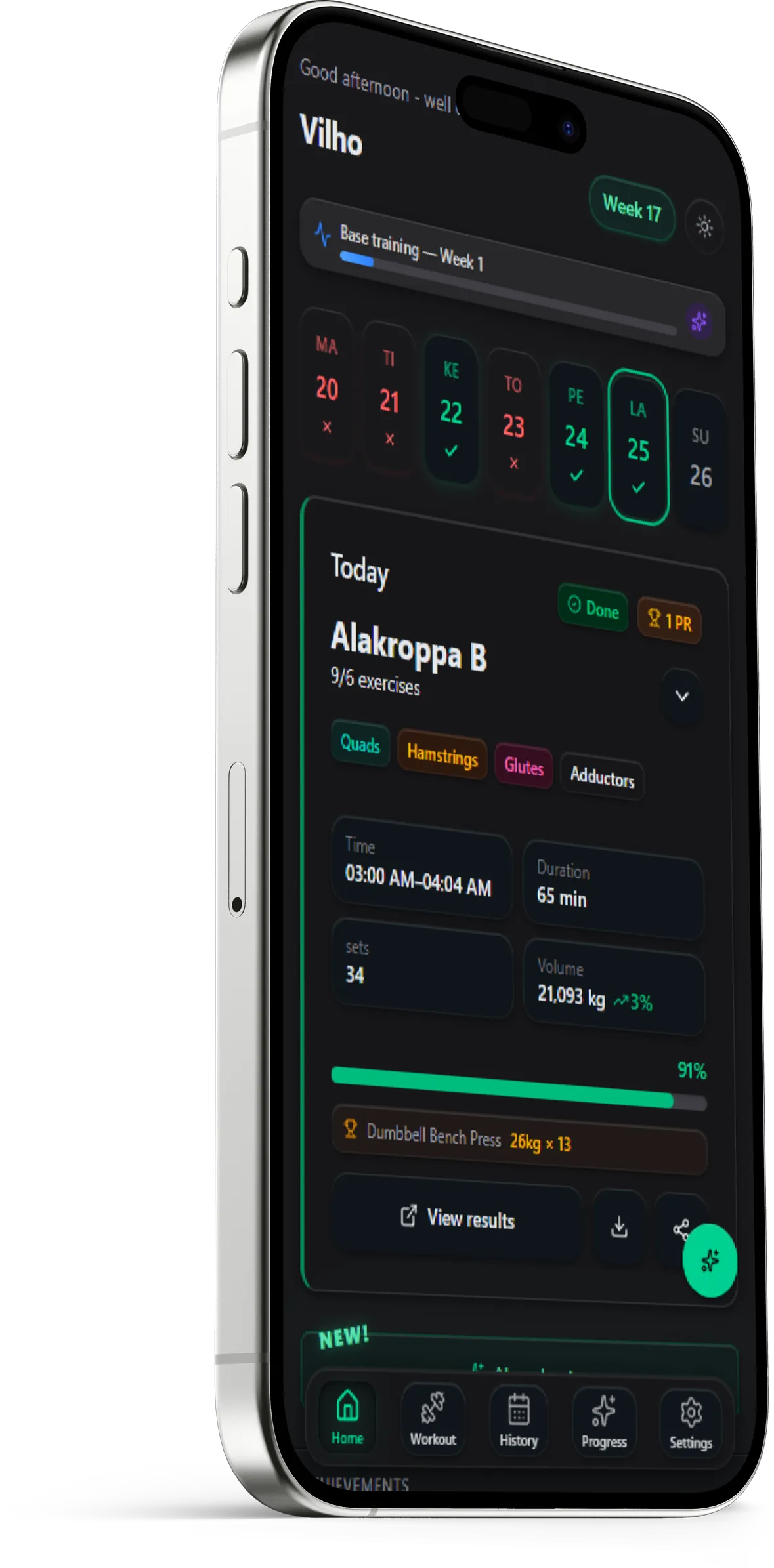
Yes. Your weight shows as a trend based on weekly averages, and your waist plus 13 other measurements show as progress charts in Premium. With your training in the same app, you can see from one place whether your strength goes up as your weight does.
See also
- 01Ideal Weight CalculatorFour formulas and the BMI range by height, with honest caveats.
- 02Calorie CalculatorCalculate your daily calorie needs and macros based on your goal.
- 03Calorie Deficit CalculatorCalorie deficit, weekly rate and an estimated date for your goal weight.
- 04Body Fat CalculatorBody fat with a tape measure: waist, neck and hip.